First Things: Relational Templates

In some ways, going through the things you believe is the easy part of a faith transition. Much harder is adjusting the patterns you’ve internalized and may not consciously realize exist.

One way this issue shows up is in relationships. It’s easy to follow Mormon patterns for relationships, which I’m calling relational templates.

Does Mormonism Even Have Relational Templates?

I’m sure that some people will argue that Mormonism doesn’t give you templates that relationships are supposed to adhere to. And sure, these roles and responsibilities are not as explicit as the five relationships of Confucianism, or at least Mormon roles and responsibilities don’t tend to be listed out together.

But that doesn’t mean they don’t exist. It just means that they’ve wormed their way deep into your subconscious, guiding your expectations and probably stressing you out without your knowing why you’re stressed.

Are You Striving for Sameness?

One tendency Mormonism might have given you is the need for sameness in the name of unity and harmony.

According to 3 Nephi 11:29, contention is of the devil, and that teaching often gets applied to all disagreements. To eliminate disagreements, people have to be the same, in outlook and in behavior. This and Mormonism’s emphasis on the good of the group over the individual can lead to enmeshed relationships, in which people’s identities are all mixed up, there are not adequate boundaries, and your sense of identity is overly twisted up in your relationships to others.

This tendency is exacerbated by Mormonism’s tendency to make everything a moral issue. If one person believes the Spirit has told them that x thing is bad, then they may try to prevent their loved ones from having anything to do with it.

Enmeshment may look like your parents expressing intense feelings on your childcare arrangements or like a couple having a crisis over different interpretations of “keeping the Sabbath day holy.”

Enter differentiation, which means learning to form and maintain your own identity while being in relationship with others. In your post-Mormon life, that might mean getting comfortable having different beliefs about the existence of a god, different religious affiliations, and even different values from loved ones.

Whether a relationship is worth continuing is highly individualized, but often we just have to learn to accept relationships and people for what and who they are. Sometimes we have serious differences with people we love and want to stay in relationship with, and no amount of righteousness or therapy tools will change that. No relationship is perfect, so sometimes, others will disappoint us, and our conversations may make us uncomfortable or annoyed.

How Should Parents and Children Relate?

Mormon children are taught to be obedient. We read this in the 10 Commandments (Honor thy father and mother). We hear this in Primary songs (“When my mother calls me / quickly I’ll obey!”). We hear this in conference talks (“The first and most important action a child can learn is obedience“).

But if you’re no longer a believer while your parents are, then you can’t obey your parents in the thing they care about most: believing in the LDS gospel. And that probably fills you with guilt even if you don’t believe you ought to live your life for your parents.

I have felt tormented by feelings that I’m a bad daughter. At the core of my guilt was a question: What does being a good daughter mean if it doesn’t mean duplicating my parents’ lives and obeying them? I had rejected the Mormon mold, but without consciously replacing it or rejecting the need for a template altogether, I kept unconsciously trying to fit myself to the only mold I knew.

This template can also affect how you relate to your children. Even if you don’t believe in authoritarian parenting, you might still live out this pattern by expecting to control what kind of person your child turns out to be. After all, you’ve been taught that if you “train up a child” a certain way, they’ll stick with it (Proverbs 22:6).

While I think that wanting your child to, say, be kind and not murder people is normal and good, expecting to be able to direct your child’s course in life with any specificity is authoritarian parenting. That’s expecting obedience.

Along with differentiation, it helped me for my therapist to ask what I expect of my child, then apply that to myself. What does it mean for my child to be a “good child”?

And honestly, that feels like a gross question. My child is my child. They don’t have to earn “goodness” in my eyes. In my mind, the responsibilities of the relationship are on me, not them. Any help them might give me when I’m old, etc., is an extension of any positive relationship we’ve built, not a payment for a debt they incurred by being born. They get to be their own person and ultimately make their own choices, even if I don’t like those choices.

How Should Significant Others Relate?

In Mormonism, “significant other” mostly means heterosexual marriage. Husband and wife. Equal partners, but also the husband presides. We don’t have time to delve into that contradiction, but suffice it to say that you can consciously believe in having an egalitarian marriage while also feeling compelled to live out your gender role in your relationship.

This might feel like guilt for not reaching the unattainable perfection of your role, like a confusing attraction to roles you reject, or like ambivalence about how you and your SO have decided to divide up responsibilities. It can feel like stress no matter what choices you make.

So now you get to ask yourself: What do equality and equity mean to you? What does it look like for you and your SO in a world in which splitting roles evenly can be impossible? How might your arrangements change over time? What do masculinity and femininity mean to you?

How Should You Relate to Your Ancestors?

If your family has been Mormon for generations, you likely have some enmeshment issues not only with your parents but also with your ancestors, specifically the ones who converted to Mormonism and went through major events you’ve been taught about.

Enmeshment, or overidentification and involvement without boundaries, with your ancestors might sound like this: You don’t want to be the weak link in the chain. If they can endure polygamy, you can endure the idea of it. Your grandmothers gave birth in the back of a covered wagon, so who are you to complain? It’s your responsibility to redeem the dead who weren’t blessed with Mormonism. Your ancestors are the reason you’re alive, and you need to repay them by honoring their legacy.

Now you get to clarify your identity.

On the one hand, your ancestors do inform your identity, and having a sense of where you came from, for better or worse, can be grounding, as can positive family traditions. Family history can give you a positive sense of self.

But there’s also no need to glorify the dead white supremacists that many members of the church are descended from. And you probably will not be as interested in your sixth cousins’ temple ordinances.

The key is to figure out how you want to relate to your ancestors. Do you believe in metaphorically redeeming the dead by trying to find solutions to problems they created or by telling their stories? Do these people matter to you, or are they just dead racists? Do you want to learn about your heritage?

How Should You Relate to Other Family Members?

In my neck of the woods, family is family, and you’re stuck with them. To an extent, I still believe that, but over time I’ve also gotten better at having boundaries.

Which family members do you want to have a relationship with, and which people might you be better off not keeping up with?

How Should You Relate to Friends?

Friendship, for me, is the type of relationship that has been easiest to change the template for. As a believer, I always felt pressure to share the gospel, either explicitly or by example. It’s felt really good to be relieved of that pressure and just have a good time hanging out with people. It’s hard to bond when in the back of your mind you’re running a script about changing the other person.

How Should You Relate to Authority Figures?

Faith in Mormonism is largely about loyalty and obedience to leaders. This can make it hard to join groups after you leave the church, even if a new group has a different template for relating to leaders.

People often comment on how ex-Mormons keep looking for new prophets—not necessarily religious figures but sources of wisdom that we’re prone to putting our faith in and not viewing as fully human.

In most areas of post-Mormon life, authority figures are experts or consultants on a particular topic. You don’t owe them fealty, and their domain is not your whole life. This is easy to know in your brain, but we all have to watch ourselves for the subconscious tendency to do this.

Do We Need Relational Templates at All?

These are not the only Mormon patterns you’ll run in to, but they’re some of the major ones. Underlying all of the stress you might feel from them is the need for a pattern to follow. But maybe there’s not an authorized way you “should” relate to others.

Consciously, I did not think that I needed a model for how to relate to my parents, and I thought I’d never accepted the hierarchical pattern for relating to my husband. But indoctrination is a beast, and in talking out my issues with my therapist, I realized that my brain always wanted a mold I could fit my relationships into. Working through this need, I realized that I believe that relationships are dynamic and individual and thus don’t fit into universal molds.

What about you? How do you relate to the patterns I’ve outlined here? Do you think it’s helpful to have templates for your responsibilities to others, or do you prefer for each person to define their relationships themselves?
First Things: Lenses of Interpretation

We look at the world through lenses—the ones in our eyes, in glasses, in binoculars, in microscopes, and in telescopes, to name a few. And whatever lenses you use, you’re going to see different things.

When you’re Mormon, especially if you were raised Mormon, you learn to see the world through the lens of Mormon faith. And in the orthodox Mormon world, you’re not encouraged to use other lenses. You see the world from a Mormon perspective and learn Mormon patterns of interpretation.

If your Mormonism has been more nuanced, you may have learned to use multiple lenses, but you probably also kept prioritizing the Mormon lens for as long as you were a believer. The Mormon lens has probably felt like your eyes themselves. It may still.

Faith transitions don’t automatically come with new training for your eyes. Having the Mormon lens in your collection is not bad, but if you go through the world not believing in Mormonism but still viewing everything primarily through the lens of Mormonism, then you might have some unnecessary problems.

We want to get some more training.

So today we’ll talk about some different ways of interpreting the world, drawing heavily from my study of English literature, to get your brain started on exploring different lenses of interpretation.

Fundamentalist Thinking Vs. Pluralism

Fundamentalist as used in this post is a general term that is not about fundamentalist Mormonism, though people from groups like the FLDS and AUB will have fundamentalist thinking patterns just like people from groups like the LDS will.

When we talk about fundamentalist thinking, we’re talking about literal, strict, unyielding belief, about believing you have the one right way of viewing the world.

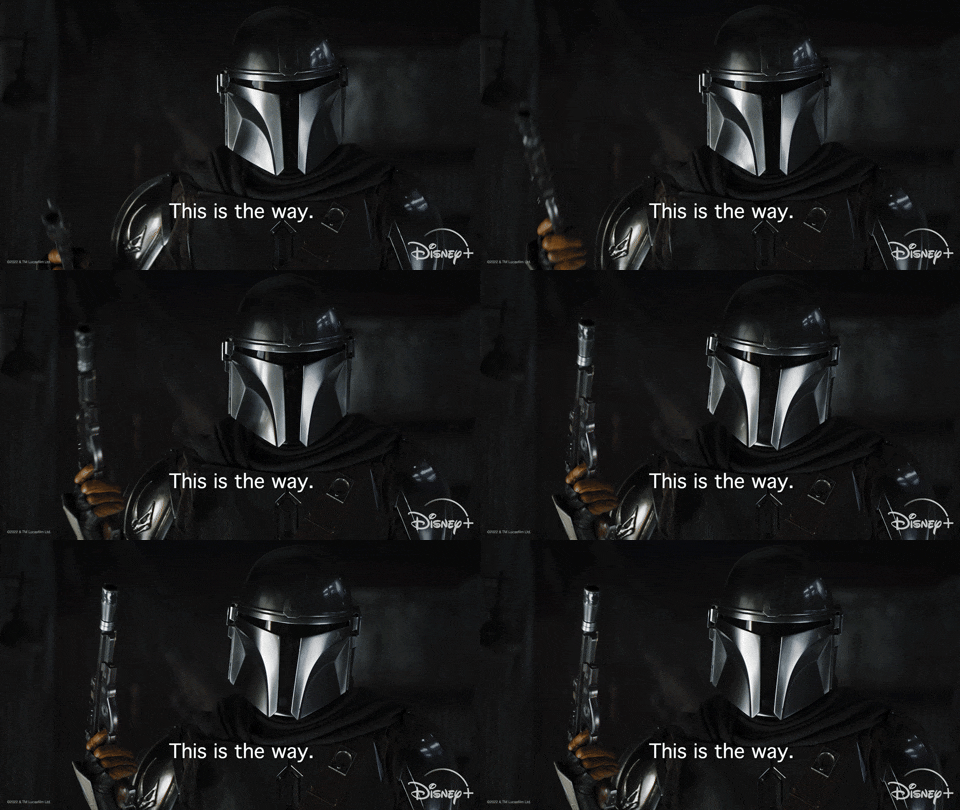
The Mandalorian says "This is the way."

The Mandalorian says “This is the way,” a refrain of his fundamentalist group.

In this respect, anyone can be a fundamentalist. There are many atheist fundamentalists. But here’s the trap of fundamentalist thinking: it makes you think that you know what’s best for other people and may lead you to try to control them.

And we don’t want to do that. Sure, we all think we’re doing what’s best, at least for ourselves. That’s why we’re doing it. But if we want the liberty to be in charge of our own lives, we need to give others the same courtesy.

So we want to develop more nuanced and pluralistic thinking. To do that, we’ll want to learn to see the world through multiple perspectives, without one perspective being our sole means of vision.

Formalism Vs. (Historical) Context

In literary criticism, there’s formalism, which, for the purposes of this post, is analysis that doesn’t take into account context outside of the text itself, like the author’s life or the historical backdrop. Formalist scholars argue(d) that any real meaning should come from the text itself. Given that not everyone with access to the text also has access to background information, this approach is theoretically more egalitarian.

But obviously, formalism has its limitations. If an English teacher were to teach The Grapes of Wrath without ever mentioning the historical context of the Great Depression, then I’d have some questions. And in Mormonism, the historical claims are key to the truth claims.

So why do I bring up formalism, if it’s not the One Way to meaning? Because studying formalism teaches us that context can actually change or create meaning.

For example, LDS temple rituals have a very different meaning when viewed in the historical context of the signs being connected to penalties. If you’re like me and did not know about the penalties until after leaving, then you may have sat around the Celestial Room with friends discussing what the signs could symbolize re: the Holy Spirit, faith, obedience, and repentance.

An interpretation that takes into account historical context and the teaching that the temple endowment is eternal is much more disturbing. In this interpretation, you were agreeing that you’d prefer to die in a horrible manner rather than reveal the signs and tokens you need to pass by the angels and enter heaven, yet you weren’t allowed to know what you were agreeing to.

Obviously, this tends to make ex-Mormons angry, and our anger is valid. Key information was withheld from us, and informed consent is important.

Luke calls Obi-Wan Kenobi on his lame justification for lying to him about what happened to his father.

But the “context can create meaning” lesson goes both ways. Any peace or meaning you previously found in Mormonism may not have been God-given or objective, but it still existed. If your loved ones don’t want to know the history of the endowment, or if they do and choose to interpret the temple rituals without historical context to preserve their own peace, that doesn’t mean their peace is fake. The meaning they find is subjective, like everyone else’s, but it’s theirs to choose, not yours or mine.

Obi-Wan Kenobi tells Luke Skywalker, "So what I told you was true--from a certain point of view."

Obi-Wan Kenobi justifies lying to Luke about what happened to Luke’s father.

Using historical context is not the One True Way to find Meaning. Meaning is subjective and involves the interplay of a text itself, the context it was written in, and the context it is read in, including the mind of the reader or listener.

When we acknowledge that context impacts meaning, we can validate our own anger and interpretation while being genuinely happy that our loved ones find peace and meaning in their religious worship. If they feel peace in the temple rather than anxiety, then awesome.

Context also helps us understand members who get mad at us. “You’re taking that out of context!” is a common criticism ex-Mormons (or progressive Mormons) face when we put things into historical context. What a TBM really means when they say this is that we’ve taken something out of the context in which the believer feels good about it. Therefore, in their mind, we must have put things in the wrong context.

I’d argue that the historical context is so key to Mormonism’s truth claims that putting things into historical context is if anything more “correct” than a formalist analysis, but that’s not the point. The point is that members often “come to their own understanding” of the gospel by separating their belief from history. And if they want to do that, then that’s their choice, not mine. Context impacts meaning and so can lead people to different conclusions.

Structuralism Vs. Deconstructionism

With structuralism (again, simplifying for the purposes of this post), we look at common elements in texts and analyze the (allegedly) universal structures as creators of meaning. A common example is the hero’s journey, in which a hero goes through key steps like a call to adventure.

A good thing that comes from structuralism is the ability to find commonalities between different worldviews and analyze systems. A problem with structuralism is that when we try to identify the universal, we necessarily do that from our own points of view and thus superimpose our worldview onto structures to which they don’t apply.

For example, the hero’s journey has been presented as the narrative arc of every character, but it’s not. Feminist critics in particular have criticized the hero’s journey as being too male-centric to apply to many women’s stories.

Margot Robbie as Barbie asks, "Do you guys ever think about dying?"

Barbie asks the other Barbies if they ever think about dying.

This is relevant to faith transitions for a couple reasons. First, since Mormonism was taught to you as universal truth, when you stop believing, your brain will still be comparing everything you see with Mormonism and possibly seeing too much of Mormonism in other systems.

For example, some ex-Mormons are understandably very wary of new communities once they leave Mormonism. However, not all communities function by the same rules. For example, it was an adjustment for me to go to a Unitarian Universalist church and realize that words like faith, religion, covenant, and god mean different things there from what I’d considered the definitions.

Second, structuralism inspired deconstructionism, which you might have heard of. People online often refer to religious deconstruction, and in the context of faith transitions, that means examining your past beliefs and patterns, clearing out what you don’t want, and keeping what you do. When people casually say they’re “deconstructing,” that can mean any sort of faith transition and does not necessarily mean they’ve become atheists.

Deconstructionism in philosophy and literature is related but different—it’s an approach that involves identifying the flaws and contradictions in a system or theory and dismantling it. In literature, this approach does not necessarily mean undermining the value of the text itself, just in analyzing the value of a theory about a text. In philosophy you deconstruct the ideas themselves, thus creating a new philosophical text that can be deconstructed, and so on (until you arrive at nihilism).

We can learn a couple things from deconstructionism. First, from philosophical deconstructionism we learn that you can logically deconstruct any worldview until objective meaning does not exist. (Historically, structuralists were reacting to existentialists and wanted meaning to be objective and universal. Deconstructionism swung the pendulum back.) However, we can also learn from literary deconstructionism (and existentialist philosophers) that you can still find meaning, even if it’s not inherent in the text or in life by itself.

So if you do deconstruct to nihilism, then don’t give up on finding a sense of meaning for yourself. The lesson isn’t that there’s no meaning possible but that there’s no inherent or universal meaning. Life can be worth living even if there’s not one way everyone should live.

Political -Isms

Other common lenses you may gain as you go through your faith transition, if you haven’t already, have to do with analysis from a political perspective. For example, you can analyze a text or an issue from the standpoint of feminism, racism, classism/Marxism, ableism, etc.

Revolutionary character from Les Miserables looks toward the viewer. The caption says, "# Who dares speak of something else than revolution?"

The rich boys of Les Mis try to unite the poor in rising up against their rich oppressors.

I encourage you to learn about these topics and regularly use these lenses. However, as with atheism, you want to keep the caution about fundamentalist thinking in mind. When you analyze a literary text from a point of view such as gender, the point is to interpret everything through that lens and see where that takes you. For literary analysis, this is fine.

In real life, multiple lenses can apply at once, so what seems like a clear-cut case of right and wrong when an issue is viewed from just one lens gets much more complicated when you use multiple lenses (also called being intersectional). You have to use your judgment, not rely on any one theory to spit out an answer for you.

For example, white women often use the lens of feminism to guide their interactions with men, but when interacting with men of color, we also have to consider the impact of anti-Black racism. A white woman who vents about a white man will likely be ignored. A white woman who complains about a Black man could get him killed. That doesn’t mean we can’t address issues of sexism with Black men, but that does mean we white women need to do so very carefully and follow the lead of Black women, who have to see through both lenses, in doing so.

To sum up, the world is complicated, and there are infinite ways to see it. Mormon teachings can give the illusion that there’s always one right way to view an issue and that there’s always a clear right and wrong. Like, literally, some of the lyrics to the hymn “Choose the Right” are “there’s a right and a wrong to every question.”

As you go through your faith transition, you will probably lose your sense of certainty about the world—having it all figured out or knowing the right way to live. But if you acknowledge that things are complicated and that you don’t have it all figured out, then I hope you’ll gain more authentic, rewarding relationships and be free to find the path that will hold the most meaning for you.

Free Will, Part 5: Self-Improvement and Mental Health

Today’s discussion of determinism is about how it can help us make positive changes in our lives and be more mentally healthy. 

If you’re just coming to this series, you may want to read the other posts first:

If you’ve already read parts one through four, then full steam ahead!

A Background of Mixed Messages

In the church, you probably got mixed messages, philosophically speaking, about how to achieve positive behaviors and avoid doing forbidden things.

For example, you might have been told to be morally strong/virtuous and “just say no” to drugs or premarital sex. That’s a free will approach.

But you may have also gotten a more deterministic approach that focused on controlling the factors that can lead to one doing drugs or having extramarital sex.

For example, various young adult leaders gave my classes a million suggestions for how to not have sex outside of marriage. Don’t be alone in the dark; don’t go in their bedroom; don’t have a long engagement. We were told, “you can’t rely on your making the right choice in the moment. You need to decide in advance what you’re going to do.” 

Because Mormonism is compatibilist, it often offers a mixture of practical suggestions and straight shame in an attempt to produce certain outcomes. And while your goals for what outcomes you want now are likely different (for example, you likely believe that it’s fine to have sex outside of marriage as long as everyone’s consenting and no one is cheating), you might still unconsciously fall back on a free will approach that leaves you with shame.

Patterns of behavior die hard. So does shame.

Agnes from Despicable Me in the Box of Shame

Agnes from Despicable Me in the Box of Shame.

Let’s talk about some common situations in which you may still be trying to willpower your way through with a free will approach.

Habits and Goals

First, you may be beating yourself up when you don’t reach goals and form positive habits rather than looking at why you haven’t been able to reach your goals and working with what you can. 

A common situation is with nutrition. Let’s say I have a tendency to binge on sugar, which I do, and that I want to eat less sugar in the form of ice cream, which I also do. Mostly.  

Shaming myself for not having enough willpower is unlikely to help, but it’s the nutrition solution I’m most familiar with. Determinism, however, would suggest that I look at my body chemistry and emotional needs. I already want to be healthy; that’s why I feel shame and avoid telling my husband when I eat more ice cream at once than is advisable at once.

When I look for reasons I’m eating too much sugar, I may determine that I have cravings that compel me to come back to the ice cream because of my insulin or glucose levels. If so, I could eat ice cream with fruit and nuts so that the protein and fiber slow the arrival of the sugar into my bloodstream. Or maybe I should buy ice cream in those overpriced pints so that if I do eat it all, I can’t eat that much at once. 

A man studies, jumping around from book to book rapidly.

A man studies, jumping around from book to book rapidly.

Another example is any habit you try to form if you have ADHD. People with ADHD often are told or feel that they are lazy, but in fact their brains just work in a different way and so need different solutions. If you have ADHD or a brain that acts similarly, you can look at tools and organizational ideas that other people with similar brains have created to be more successful. You can work with a psychologist who specializes in ADHD and can explain to you how your brain works. 

You don’t just need to work harder or care more. If you want to get something done, the secret is not just wanting it more. That’s just another form of insisting that if you have faith, miracles will happen.

Social Attitudes and Self-Esteem

Next, let’s talk social attitudes and how they affect self-esteem. 

Our society—and most societies, but I’m specifically referring to Western and American society here—tends to be misogynistic, white supremacist, homophobic, transphobic, ableist, fatphobic, and more. 

And because you can’t just magically opt your brain out of social conditioning, you’ve inevitably internalized negative messages about yourself and others that make you feel shame and reduce your empathy for others. The way to counter that messaging is not just by being strong and ignoring it. Social conditioning is going to affect you. It’s in your head, affecting your biases already, and you don’t have to feel ashamed about that.

Characters from The Bold Type, one of which says, "The patriarchy hurts, okay?"

Characters from The Bold Type, which is a TV show I haven’t seen but would probably like, based on the GIFs I’ve used from it.

But you’re still in charge of what’s in your brain, influencing your decisions. To counter our negative conditioning, we need to seek out feminist, anti-racist, LGBTQ+-affirming, anti-ableist, and body positive messages so that we can slowly change our social conditioning to something more positive. We also need to set appropriate boundaries to protect our mental health from messages that could get us to view ourselves or others in prejudiced ways. 

Abuse

On a related note, you can’t willpower your way out of abuse affecting you emotionally.

This is why plenty of celebrities have had to go off social media when they’ve been harassed and subjected to verbal abuse online. They weren’t being cowardly, just realistic about how brains work. You’re likely to internalize messages you’re continually exposed to. 

If you’re being abused and can safely remove yourself from the situation, then doing so may be your best option. 

Mental Illness

My last topic for this post is mental illnesses such as depression and anxiety. The church has increasingly couched teachings about happiness among disclaimers that their advice does not apply to situations involving clinical depression, but you still may have been told that you should be able to just choose to be happy or use a positive attitude of gratitude to overcome depression. 

If you believe in free will, then you likely believe that you choose your emotions and have conscious control of them. Even after you stop believing in Mormonism, it’s very easy to keep this attitude because you may not realize you have it. It’s just the water you’re swimming in.

Actors from The Book of Mormon musical singing about how a nifty Mormon trick is to just turn unwanted feelings off.

However, determinism affirms what you’d learn in therapy—that we don’t generate or control our emotions so much as we observe and manage them. 

There’s a lot we can quote and say about church teachings about happiness and how they affect people with mental illness, but for now, I’d encourage you to watch for ways in which you still may be expecting yourself to use free will to be happy. 

For example, you may think that you should be able to change your thinking patterns without a therapist’s help. Or you may think that maybe a therapist could help you with your thought patterns but that you shouldn’t need medication. 

One important moment for me was when my doctor very kindly explained to me that depression can be caused by a lack of necessary chemicals and that being opposed to taking antidepressants was similar to being opposed to putting a cast on a broken leg. I knew that and wasn’t opposed to antidepressants in general, but I still unconsciously had the attitude that I personally shouldn’t need medication. 

Sure, happiness can be influenced by our attitude. But the thing is, your brain wants to be happy. So if you’re not and haven’t been, there’s a reason, and it’s probably something someone can help you with. If you get help, you may be able to address that reason, whether you could benefit from cognitive behavioral therapy to help with thought patterns or need medication to help with your brain chemistry. 

Even if you technically have the things you need to help yourself be happy, you shouldn’t expect yourself to know what to do without guidance. For example, yes, changing your thought patterns can help with depression, and you can do that with your brain, which you already have, but without knowledge of cognitive behavioral therapy, you still can’t do it. 

In the Wizard of Oz, Dorothy had the ruby/silver slippers on her feet the whole time, but until Glinda told her how to use them, Dorothy had no way of knowing that she had the power to get back to Kansas. How was she supposed to guess that she could’ve just clicked her heels and talked about home?

Judy Garland as Dorothy in The Wizard of Oz, showing off the ruby slippers as Glinda's wand points to them.

Judy Garland as Dorothy in The Wizard of Oz.

Seriously, Glinda, you should have mentioned that back in Munchkin Land. Yes, Dorothy would’ve believed you. She believed you when you told her that she needed to walk down a yellow brick road until she got to a wizard, didn’t she? 

Like, Dorothy, you don’t need to feel ashamed that you didn’t magically figure out what the solution was on your own. And there’s no shame in having believed you can power your way through your problems with agency either. That’s what you were taught your whole life. Even if walking the yellow brick road to see the wizard isn’t what worked, you did it because it was your best option based on what you knew, and our brains respond to social conditioning.

You’re not weak for being human. 

And that’s a decent tagline for determinism.

Free Will, Part 4: Moral Responsibility and Criminal Justice

We’ve talked about whether you should deconstruct free will, contextualized Mormon teachings in the wider discussion of free will, and clarified the differences between supernatural fatalism and determinism.

If you haven’t read the previous posts, then you can find them here:

Now we’re on part four of our free will series, in which we’ll talk about moral responsibility and criminal justice.

CW: discussion of abuse and violent crime

Moral Responsibility

One controversy with determinism is that it affects the idea of moral responsibility. If you couldn’t have chosen differently, then are you really responsible for your actions?

Well, yes, but not in the way we have traditionally thought. 

You still make choices that have consequences, and ethics and morality still indicate that you should try to not harm people and should try to make up for harm you do. That doesn’t change.

Gordon Ramsay saying, "I just want some form of responsibility somewhere."

Gordon Ramsay being Gordon Ramsay.

Determinism just helps us to have less shame when we mess up. We didn’t do something bad because we are bad, we did it because of a number of factors that can be identified and then managed so that we don’t continue to harm others.

Then, instead of beating ourselves up and trying to magically will ourselves into different behavior, we can actually change our behavior, make restitution, and move on.

Free Will and Criminal Justice

The more you believe in free will, the more you will think that crime happens because people choose to do bad things and could have done differently. For example, in Les Miserables, Jean Valjean is harshly punished for stealing bread to feed his nibling. If you’re a compatibilist or a determinist, then you probably don’t think Valjean is a bad person for doing this. You likely believe that he was justified in stealing bread because that’s not as bad as letting a child starve.

But if you’re Javert, then you have a free will view of the world and think that Valjean should have just found another way. There’s no excuse, in Javert’s view, for breaking the law. You’ll starve again unless you learn the meaning of the law, he sings in the musical. Keeping the law and being good, he believes, lead to prosperity. (Of course, this implies that the poor and starving are bad and the rich are morally superior.)

Valjean gets imprisoned for stealing bread and then trying to escape because punishment is supposed to teach him that he needs to be good.

Strict free will theology says that people do bad because they are bad. You punish bad people with prison, hell, etc.

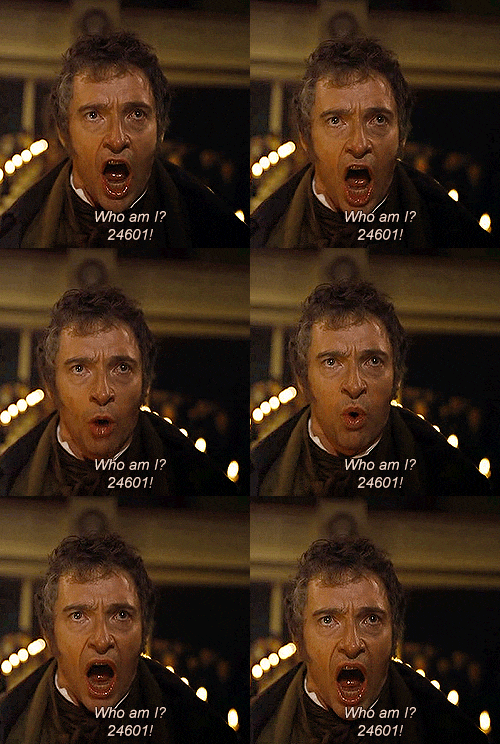
Hugh Jackman as Jean Valjean in Les Miserables, singing "Who am I? 24601!"

Hugh Jackman as Jean Valjean in Les Miserables.

Valjean, however, knows that he didn’t break the law because he’s a thief. He broke the law because there was no other way to save his sister’s child. The law is cruel and is out of line with reality. I know the meaning of those nineteen years, a slave of the law, he sings.

Authors like Victor Hugo and Charles Dickens called attention to the fact that poverty leads people to commit crimes or engage in antisocial behavior in order to survive. Their books helped people take a more compatibilist view toward criminal justice. Today, we think of throwing someone in debtor’s prison until they pay their debts to be an illogical and inhumane solution. Someone can’t just use free will to magically remove their hardships. How are you supposed to earn money if you’re in jail? Not very easily.

While most people today can easily understand how poverty impacts crime rates, understanding the factors that drive people who commit violent crime, especially rich people who commit violent crime, is a lot harder. 

Determinism and Violent Crime

If all our actions are determined by external factors, then evil acts are not caused by evil people. They’re caused by a perfect storm of genetic and environmental factors that lead to tragedy. And determinists think this is true not just with justifiable crimes like stealing food to feed your family but also with the worst crimes you can imagine. 

If you watch the Crash Course video on determinism or listen to Sam Harris talk about determinism, you’ll know that brain chemistry, genetics, and even tumors play a role in whether people commit violent crime or not, as do how those genetic factors interact with a person’s history. 

While we don’t know everything about why people commit violent crime, determinists believe that people don’t just decide to be evil. They do things for reasons, even though those reasons are often not rational to an outsider and even though those reasons explain rather than justify negative behavior. 

Rainn Wilson as Dwight Schrute in The Office (dressed here as a Sith Lord for Halloween).

Rainn Wilson as Dwight Schrute in The Office (dressed here as a Sith Lord for Halloween).

This shift in perspective has profound implications for our criminal justice system. Determinism indicates that even murderers and child abusers are not evil—they’re unlucky.

Does a lack of free will mean that we have to let people go around committing whatever crimes they want to? Of course not. People still make choices and do things, and those actions impact others. As a society, we still decide together which behaviors we’ll accept and which we will not. 

In cases of violent crime, the perpetrator needs to be separated from society for the protection of others, but they need rehabilitation, or in severe cases at least containment, rather than punishment. Just punishing people isn’t likely to change their behavior, and it’s cruel to inflict punishment on someone who’s unlikely rather than evil.  

Implications for Abuse Cases

Part of the appeal of this philosophy to me as an abuse survivor is that I understand that it’s very hard to put abusers behind bars. Evidence is often difficult to collect and present, and it’s nearly unheard of for abusers to agree to go to prison. So a lot of abusers are still out there, able to hurt more people. However, I do know abusers who hate themselves for their behavior and whom I am optimistic might admit to what they’ve done if there were a path to rehabilitation that didn’t involve people viewing them as irredeemable monsters. 

I also think that part of the problem society has with believing survivors has to do with people’s inability to reconcile their view of the abuser as a person with the idea that abusers are evil and nothing else. Survivors often hear things like, “oh, but he does [good thing]!” or “but he has a family!” in defense of abusers and not holding them accountable. But of course abusers have families. As Glinda says in Wicked, “She had a father. She had a mother. As so many do!”

Ariana Grande as Glinda in Wicked, saying, "It's good to see me, isn't it?"

Ariana Grande as Glinda in Wicked.

If evil acts are caused by people being evil, then it doesn’t make sense for an abuser to be nice and good in some contexts and evil in others. But when we accept that context and external factors affects people’s behavior, we can understand that different people can have hugely different experiences with the same person. That’s not to say that being alone with children makes pedophiles abuse—there are other factors—but it does explain why an adult might not immediately clock a pedophile as such. Sometimes an abuser is nice to someone because they’re manipulating them so that victims won’t be believed, yes, but also abusers are capable of being kind to some people and evil to others. No one is all good or all evil, and that is true even in extreme cases.

If we could get society at large to view perpetrators in a way that is more nuanced without blaming or minimizing the devastating impact their actions have on victims, I think we might address more problems and be more willing to acknowledge the devastating prevalence of abuse.

A More Just Society

To have a healthy society with a deterministic worldview, we need people to evaluate actions in terms of how those actions harm or otherwise affect others, not just in terms of a person’s being good and evil as decided by the Christian god. 

With a free will view, it’s easy to focus on intent and thus excuse the harm someone does by saying, “oh, well he meant well,” or “oh, but she’s trying.” If bad actions are caused by evil, and if the people in authority don’t believe that the perpetrator is evil, then we’re likely to think that their actions could not have hurt people very badly. In so doing, we minimize or disregard the suffering of the people they hurt.  

Certainly intent can be relevant, but “the road to hell is paved with good intentions” is traditional wisdom for a reason. Most people are trying their best, but good intentions don’t stop us from hurting others. 

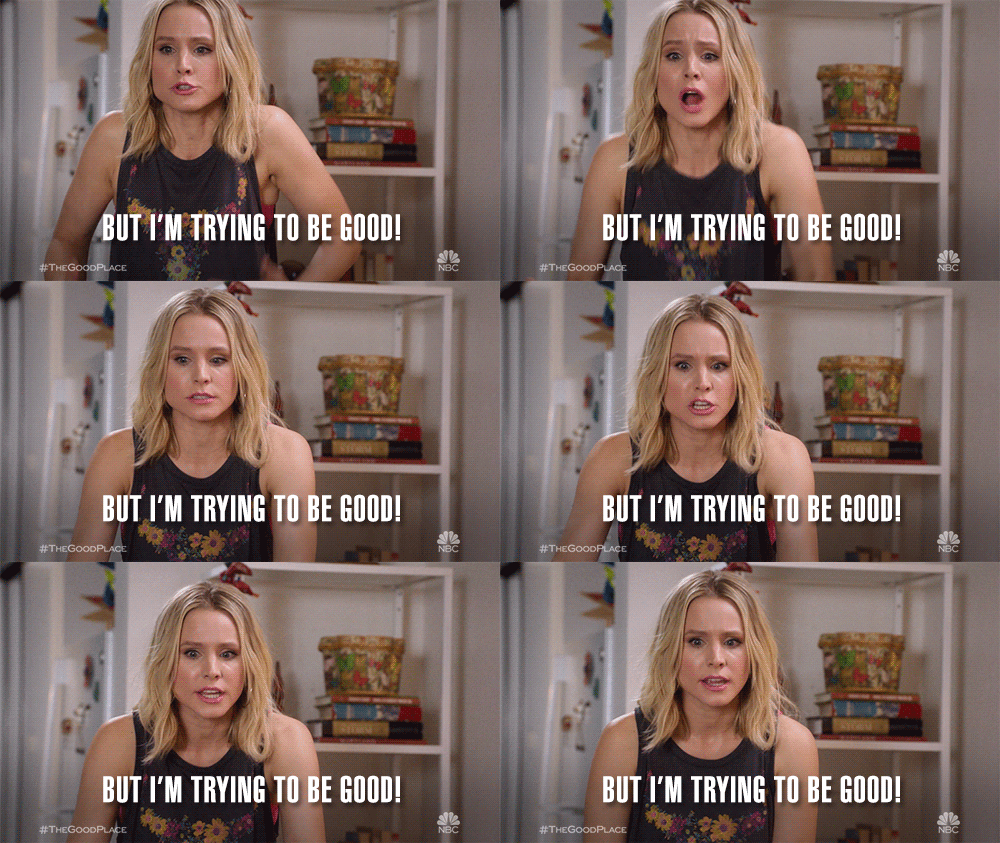
Kristen Bell as Eleanor Shellstrop in The Good Place, saying, "But I'm trying to be good!"

Kristen Bell as Eleanor Shellstrop in The Good Place.

One of the great things about determinism is that it allows us to view others as trying their best without requiring us to minimize the harm that any given person causes. 

So yes, with a deterministic worldview, we still respond to people’s choices by imposing consequences. The difference is, we’re not going to label the person as evil, and our emphasis is going to be on addressing the cause of the behavior rather than on punishment. If a person can’t be rehabilitated, we don’t need to release them into the world to go on killing sprees or whatever. But we also don’t need to be cruel to them to teach them a lesson. We just need to contain them for the protection of society.

Those are my thoughts. What are yours? Do you think this approach would improve society? If not, what would your approach be?

In part five, our final post of the series, we’ll talk about determinism, self-improvement, and mental health.

Free Will, Part 3: Fatalism in a World Without Magic

In parts one and two, we looked at the pros and cons of deconstructing free will and contextualized Mormon teachings on agency in the larger philosophical discussion of free will. Read those posts first if you’re new to this discussion.

Today we’ll talk about fatalism, which can unconsciously influence your ideas about determinism and make you feel helpless and out of control. The solution, or at least a solution, is to get rid of the magical thinking that you learned along with the theology of free will / agency. Once those concepts hold no more power, determinism is reduced to “things (mostly) happen for reasons,” and we’ll get to leave the hypothetical stuff alone and move on to ridding the world of the bad fruits of free will theologies.

We’ll go over some examples from literature, talk about how patriarchal blessings function in a world without magic, and tie all that back to determinism. I hope that this information will help you avoid some emotional spiraling or regain a sense of control. 

Fatalism in Literature

With fatalism, fated events are inevitable. 

The most famous literary example is probably Oedipus Rex. After Oedipus’s birth, a prophecy states that Oedipus will kill his father, so that father tries to have baby Oedipus killed to circumvent fate. However, Baby Oedipus, left to die, gets adopted into another family. Oedipus, who does not know that his adoptive parents are not his biological parents, is later told that his fate is to kill his father and have sex with his mother. In an effort to prevent this from happening, Oedipus gets away from his adoptive parents. He then kills a man and marries that man’s widow, and Oedipus much later learns that these people are his biological parents. 

Gillian Jacobs as Britta Perry, who says, "So edible!" when she means to say Oedipal.

Gillian Jacobs as Britta Perry in Community.

This story is fatalistic in that knowing the prophecy does not allow you to change or avoid your fate. Fate is inevitable. 

Another play in which we see fatalism is Macbeth. After some witches prophesy that he’ll become king, Macbeth leans in to that prophecy hard, murders the king, and takes his throne. A later prophecy tells Macbeth to fear a man named MacDuff, says Macbeth won’t be killed by anyone born of a woman, and predicts that Macbeth will be safe until Great Birnam Wood comes to Dunsinane Hill. Macbeth sends some guys to kill Macduff and his family and then thinks he’s invincible. 

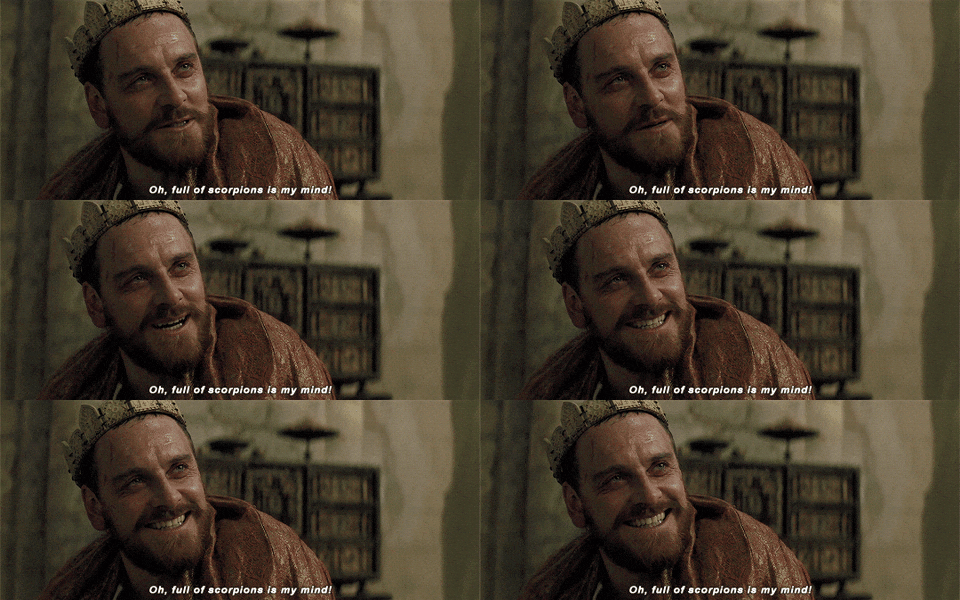
"Oh, full of scorpions is my mind," says Macbeth, played by Michael Fassbender.

Michael Fassbender as Macbeth.

However, Macbeth later learns that he didn’t understand the prophecy. Macduff survived Macbeth’s attack and now wants revenge. He comes with an army that carries branches of trees from Birnam Wood, and that apparently counts as the forest moving. And finally, the witches’ definition of “born of woman,” it turns out, does not include c-sections. Macduff was born via c-section, and he kills Macbeth. 

In both of these plays, we see that you can’t stop fate, and trying to stop a prophecy from coming true often makes it happen. 

Mormon Patriarchal Blessings

So that’s prophecy in literature. Let’s talk about prophecy in Mormonism, specifically in patriarchal blessings. 

Unlike these prophecies that are supposed to come true no matter what, LDS prophecies are contingent on righteousness. Sometimes God tells what will happen if people don’t repent, and the people can avoid painful consequences through repentance. And with patriarchal blessings, members are told that blessings depend on their righteousness. 

My patriarchal blessing told me to beware of people who tell me that they’ve prayed and received revelation that I’m supposed to marry them. I was told to wait for my own revelation and not be deceived. Now, this is a good anti-manipulation message. However, it was presented as a prophecy, which means it was hard not to worry about it happening or that I wouldn’t be righteous enough to avoid falling for the deception.

I tried not to freak out. I’d read Oedipus Rex and Macbeth, among other works of literature that talk about prophecy, and I knew that if you hear a prophecy that freaks you out, the thing to do is ignore it, or else you pretty much guarantee ironic consequences. 

It turns out, ignoring a prophesy is nearly impossible. Worry about whether guys I met were manipulative reduced my willingness to enter relationships (trying to avoid the prophecy), and wanting to get the prophecy out of the way so I could relax meant I was tempted to date jerks on purpose to make the prophecy happen and regain control. The worry was paralyzing.

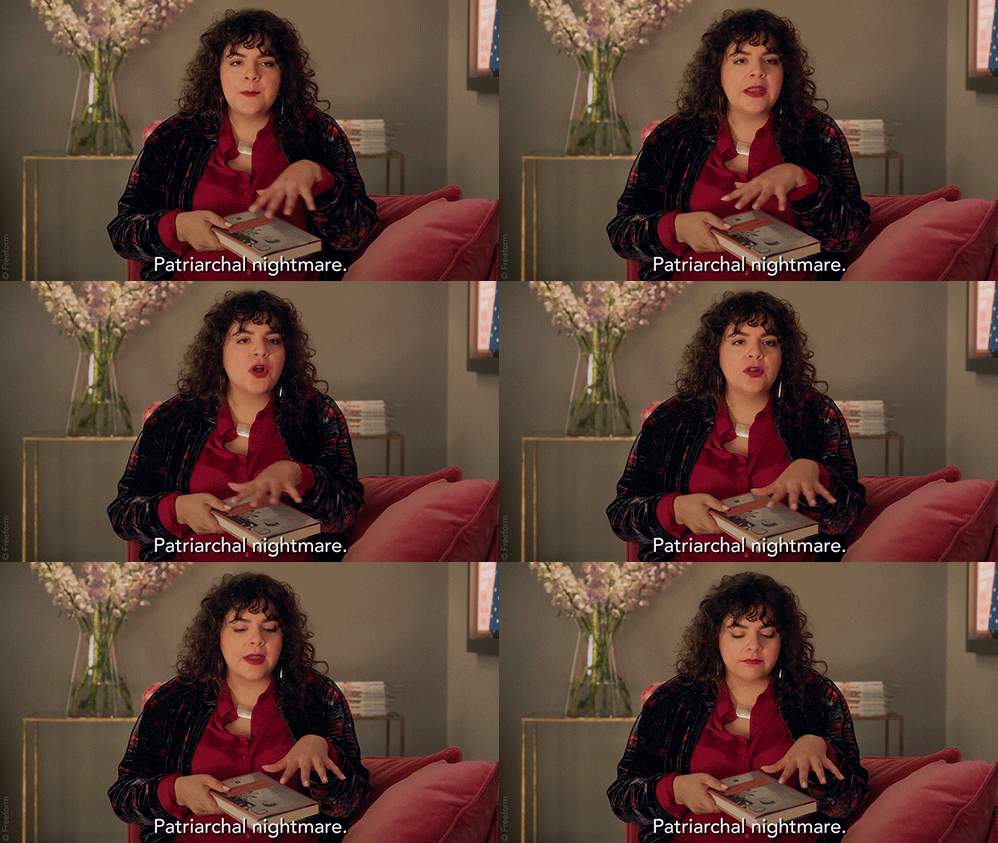
A woman with curly brown hair says, "patriarchal nightmare."

A woman from a show called The Bold Type, apparently.

Unconnected with my patriarchal blessing, I ended up doing a lot of counseling, and through that counseling, I learned about boundaries and how to have healthy relationships. 

Eventually, I got to the point where I was dating my now-husband. I wasn’t getting an answer to my prayers about whether I should marry him, and I couldn’t see any situation in which he’d be a manipulative jerk as described in my patriarchal blessing, so I didn’t know what to do. I wasn’t going to break up with him because I hadn’t dated a jerk as described in the blessing yet. That would be stupid. But I also didn’t feel like I could get married because this thing was supposed to happen before I got married for time and all eternity. At the very least, I needed a definitive answer that I was supposed to marry my then-boyfriend. If I wasn’t obedient and righteous—if I ignored the warning to receive my own revelation and decided on my own whether to marry him—then I could lose the protection contingent on my righteousness.

Fortunately, I then talked about the prophecy with a therapist who convinced me to first decide what I wanted, at which point I was able to feel elevation emotion, ie, a confirmation from the Holy Ghost, about marrying my now-husband. I was then able to ignore the prophecy in my patriarchal blessing. I decided that probably the patriarch was well-meaning but not inspired during that part, or else the prophesy was a possibility but not an inevitability. My husband and I have been happily married for years now. 

I tell you this story because what happened is exactly what you’d expect to happen with a prophecy given in a non-magical world. 

That is, the whole thing was stupid. 

It doesn’t make any sense to make major life decisions according to the rules that work in plays about fatalism because we don’t actually live in a magical world.

But if you’re on this site, you were probably raised to believe we do live in a world controlled by supernatural power, and you may still be applying logic based in magical thinking to your current life, even if you don’t believe in magic or God or any sort of supernatural power.

You may be doing this with your understanding of determinism. If we take the magical rules out, things get a lot less emotionally turbulent.

Deterministic Inevitability in a Rational World

Depending on your definition of fatalism, it can be fair to call determinism fatalistic.

Some determinists say that everything that has happened since the Big Bang has essentially been predetermined—that’s the only way things could have happened. If you rewound the universe, the exact same things would happen on the replay because all events were caused by the events that came before it, linking history together in a chain of inevitable events.

The very idea can make you feel a freaky lack of control over your own life. 

"Whoa! You just wrinkled my brain!" says Troy Barnes from Community.

Donald Glover as Troy Barnes in Community.

And determinist philosophers are not trying to help you feel better. In Free Will, Sam Harris says things like “you’re not free,” and the cover image literally has the words “free will” suspended by marionette strings. 

Baron d’Holbach said, “All of us are just cogs in a machine, doing what we were always made to do, with no real will.” 

That is bleak. (And controversial. Gotta sell those books.)

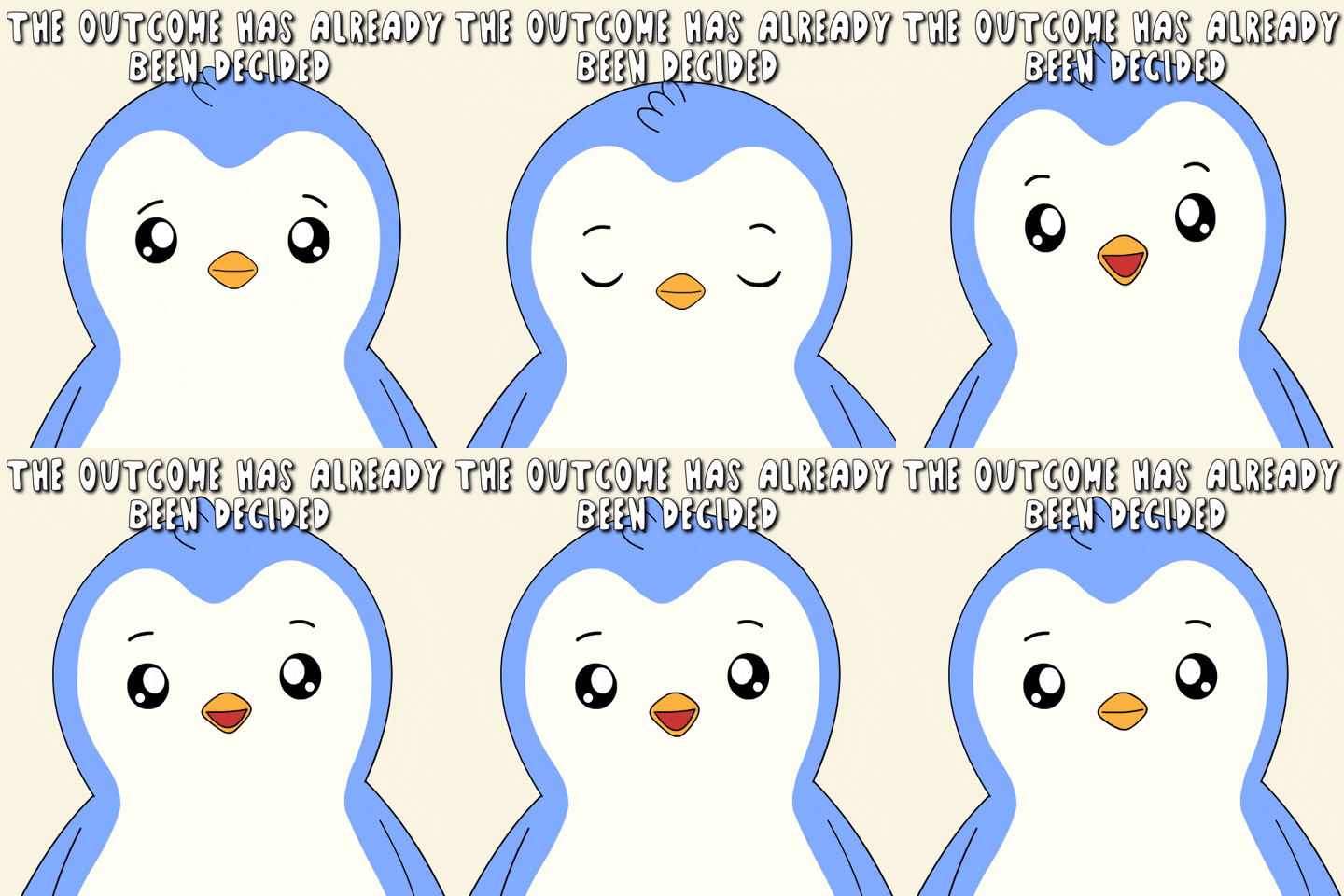
A cute penguin says "the outcome has already been decided."

Fatalism is cuter when it comes from a talking penguin.

But there’s a crucial difference between determinism and the fatalism of Greek and British drama (or Calvinist predestination or LDS prophecy): a lack of supernatural power.

Determinists tend to be atheists, and atheism makes determinism much less threatening to a sense of autonomy.

First, there are not powerful beings, be they witches, Fates, God, a patriarch, or a giant tarantula-squid, pulling the strings, telling you the future, and messing with your head.

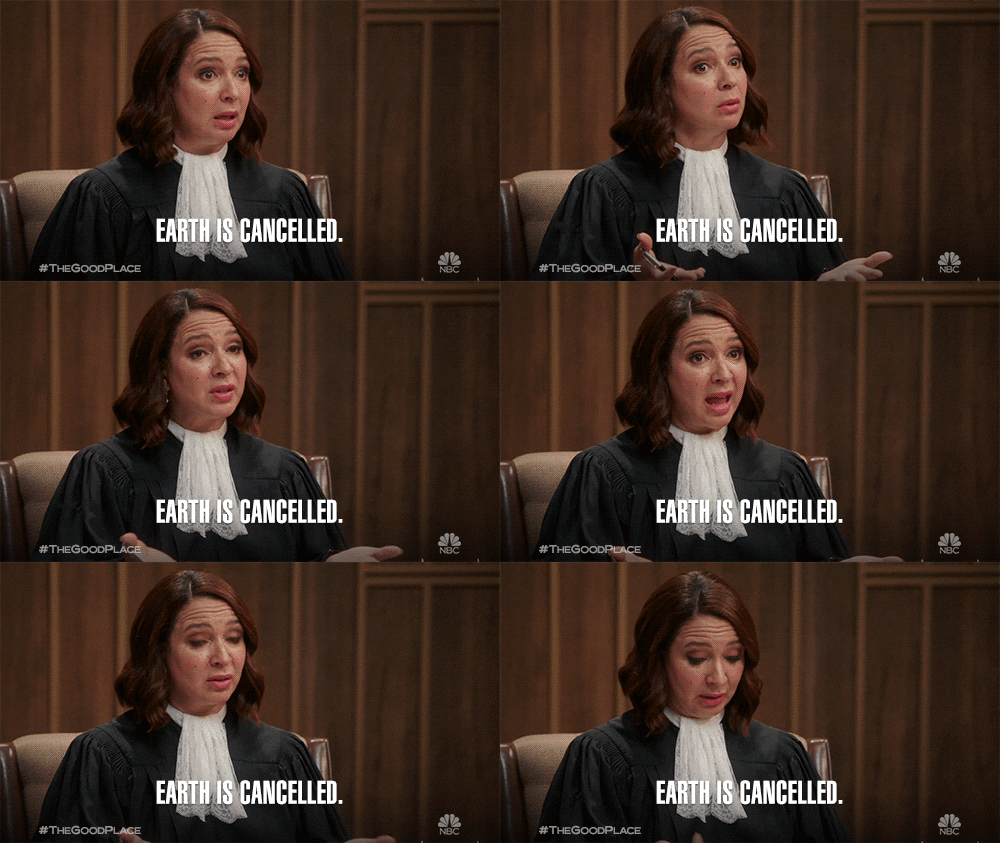
As of right now, we have no godlike supercomputer that can accurately account for every factor in the universe. So this is all theoretical, and while I personally would guess that chaos is a big enough factor for history not to be predetermined, I also don’t care a lot about this magical scenario in which we rewind the universe. Because that’s impossible. There’s no all-knowing judge who can push a button, cancel Earth, and reset the universe.

Maya Rudolph as The Judge in The Good Place declares Earth cancelled.

Second, if no one knows what’s going to happen, then that means we can’t have prophecies that inevitably come true. We have statistics and prognoses that are getting more and more accurate, but unlike in magical fatalism, where a prophecy will inevitably come true, in a rational world, knowing about a potential future means that you can act differently and sometimes avoid a predicted negative outcome if you want to. Even if you can’t avoid the outcome, like with a diagnosis of terminal cancer, the information allows you to make better choices in light of the the inevitable. So knowing information in advance is not just going to mess with your head. It’s actually helpful.  

Sure, no matter what you do or don’t do, people can say your choice was predetermined, but since they don’t have details to give you, for your purposes, an edgy determinist philosopher might as well be a psychic who goes around saying, “Ah, yes, it was as I foresaw,” even though they never made a specific prediction. 

A woman from some CBC show called Pretty Hard Cases says "because I'm a psychic."

A woman from some CBC show called Pretty Hard Cases says “because I’m a psychic.”

Or to be fairer to them, it’s like they’re going around saying, “things happen for reasons,” whenever anything happens.

And like, yeah, man. We know. Stop making it all cryptic and freaky.

Free Will Versus Choices

You probably learned about fatalism in school by reading a play (or hearing about a play) like Oedipus Rex or Macbeth. You likely learned that people used to believe more strongly in fate, whereas today we focus more on choices and our ability to choose our own destinies (a take rooted in free will theology). You may have also learned about the theology of predestination.

When we get rid of the Christian lens and doctrine of free will, our brains are liable to default to the other takes we’ve been taught about but previously rejected—probably Calvinist predestination or (supernatural) fatalism—and conclude that no free will means that our choices don’t matter.

But that’s not what determinists are saying.

In Free Will, Sam Harris writes: 

As Dan Dennett and many others have pointed out, people generally confuse determinism with fatalism. This gives rise to questions like ‘If everything is determined, why should I do anything? Why not just sit back and see what happens?’ This is pure confusion. To sit back and see what happens is itself a choice that will produce its own consequences. It is also extremely difficult to do: Just try staying in bed all day waiting for something to happen; you will find yourself assailed by the impulse to get up and do something, which will require increasingly heroic efforts to resist.

And the fact that our choices depend on prior causes does not mean that they don’t matter. If I had not decided to write this book, it wouldn’t have written itself. My choice to write it was unquestionably the primary cause of its coming into being. Decisions, intentions, efforts, goals, willpower, etc., are causal states of the brain, leading to specific behaviors, and behaviors lead to outcomes in the world. Human choice, therefore, is as important as fanciers of free will believe. But the next choice you make will come out of the darkness of prior causes that you, the conscious witness of your experience, did not bring into being” (pp. 33–34, boldface added).

Determinism is not saying that the same things will happen regardless of what you do. It’s saying that things happen because of other things that happen, many of which you can’t control or even track, not because of a person’s inherent goodness or badness or because of the will of supernatural forces.

Now that we’ve talked about fatalism, we’re done with the more cerebral examination of determinism. Now we can get to the good part—the practical reasons and benefits of liberating our minds from the stupid vestiges of the free will theology.

In part four, we’ll talk about criminal justice and how determinism can help us be more just.

Free Will, Part 2: Contextualizing Agency in Mormonism

Today, we’re going to place the idea of agency, the ability to choose good or evil, also known as free will, in Mormonism within the discussion of free will in philosophy. 

This post gets into the philosophy and theology of free will/agency, so if you haven’t read part one of this series, I’d suggest you do so if you haven’t already deconstructed free will. This process can get a bit trippy, and I don’t want anyone to go into it without as much informed consent as possible. In part one, I detail what I see as the pros and cons of no longer believing in free will.

I am not a philosopher, so for general philosophy, check out my Ethics and Moral Philosophy page, which include links to perspectives on determinism and free will. You can also read books like Free Will, by Sam Harris, which I will quote from in this post. Fair warning, the linked resources and the book do discuss some horrific crimes, including abuse and murder. 

My goal here is to contextualize agency in Mormonism within the discussion of free will and determinism. We’re matching up terms here and taking stock of our Mormonism-based philosophical beliefs as well as examining other perspectives.

Spoiler alert: you’ll probably find you’ve never fully believed in free will.

Tom Hiddleston as Loki in Loki says "This is absurd."

Tom Hiddleston as Loki in Loki says “This is absurd.”

I hope this post will be a helpful entry point to the discussion of free will.

Christian Belief

First, let’s look at agency in Christianity in general. 

One of the biggest philosophical questions that Christian theists, or believers in God, have to answer is the problem of evil. If there is an all-knowing, all-loving, all-powerful God, then why doesn’t he stop the suffering and evil in the world?

Free will (what Mormons call agency) is Christianity’s main answer to the problem of evil. God created us with the ability to choose, and humans don’t always choose to be good. 

Traditional Christianity considers man to be fallen and naturally evil due to original sin. The goal is thus for humans to use their free will to choose to become good through the grace of God, traditionally through accepting Jesus as their Savior and being baptized. Those who choose good will be rewarded with an afterlife in heaven while the wicked will be condemned to hell. 

Problems with Free Will in Christianity

However, Christianity ran into some problems with this doctrine. 

In his book Free Will, Sam Harris says: 

“The popular conception of free will seems to rest on two assumptions: (1) that each of us could have behaved differently than we did in the past, and (2) that we are the conscious source of most of our thoughts and actions in the present” (pg. 6).

Believing that everyone can choose to believe in Jesus might fly when you live in a society where everyone has to at least pretend to believe from cradle to grave. But if you interact with other cultures and areas of the world, you realize that people cannot just spontaneously learn about and believe in Jesus. The ability to accept Jesus as your Savior is to some degree dependent on external factors—at the very least, hearing the gospel preached to you. 

So you have people who have never had a chance to believe in Jesus being condemned to hell, and you’ve got babies who died without being baptized labeled as evil and condemned to burn in hell for all eternity. 

This unfairness undermines all of Christianity, so it has to adapt. Different Christian denominations have modified their ideas of free will in different ways, such as with universal salvation or baptism of desire. 

Mormon Belief

Let’s briefly review how the LDS Church gets around these problems with free will, or agency. 

In the Mormon doctrine you were probably taught growing up, agency is also the answer to the problem of evil. In fact, agency is so important that when Lucifer presented an alternative Plan of Salvation in which agency didn’t exist but everyone would be saved, God rejected that plan, and we fought the War in Heaven over the issue. 

Joseph Smith rejected infant baptism as evil and unnecessary, declaring baptism to be necessary only for people old and developed enough to understand right from wrong, which Joseph Smith identifies as people at least eight years old. “And their children shall be baptized for the remission of sins when eight years old, and receive the laying on of hands” (Doctrine and Covenants 68:27).

Thus people are born innocent and then choose good or evil. As Joseph Smith wrote in the second article of faith, “[Mormons] believe that men will be punished for their own sins and not for Adam’s transgression.” 

(At least, Mormons don’t believe in original sin if you don’t take verses like Mosiah 3:19, which says “the natural man is an enemy to God and has been from the fall of Adam” and certainly seems to be describing original sin, at face value. But that’s a different discussion.)

Doctrine and Covenants 137, which dates to 1836 in Kirtland, Ohio, also declares that people who die before receiving the gospel but who would have received the gospel if given the chance, will be saved. 

Later, Joseph Smith solves the issue caused by the technical requirement of baptism by introducing baptisms for the dead (plus there are other proxy ordinances). 

Mormonism also has degrees of glory, which allow for more nuance in the afterlife than the “heaven versus hell” binary does. 

Compatibilism

These ways of modifying free will to acknowledge that external factors have some impact are types of compatibilism. Compatibilism is the idea that free will and determinism are compatible. 

Determinism is the idea that everything is determined by causes external to human will. (Philosophers like Sam Harris do acknowledge that “willpower” as in the power to do things does exist but that it’s determined by factors that you can’t control, such as your brain structure and functioning.) So when we talk about human choices, determinists generally say that your choices are all made as a result of environmental and genetic factors. 

A compatibilist would say that external factors can be super important to our choices without that negating the existence of free will. 

Most Christians today, including Mormons, are compatibilists, though they likely don’t think about it in those terms.

Before learning about determinism, I believed in a very liberal compatibilism that was nearly determinism, though I didn’t know either of those terms. That may be where you are now. A lot of people get to that point just through empathy or observation. 

For example, let’s pretend you’re a believer talking about people accepting the gospel. The more you believe in free will, the more likely you are to say that people should let the missionaries in when they knock at the door and say they have a message about Jesus Christ. If you’re more to the determinist side of compatibilist spectrum, then you’ll be more likely to acknowledge that factors like fear for personal safety and a normal urge to not let random people into your house would keep a rational person from hearing the gospel despite coming into some contact with missionaries. 

Actors from The Book of Mormon musical dressed up as missionaries and posing.

If you were a progressive member, you might even say that things the church has done, such as banning Black people from exaltation, would understandably keep good people from recognizing the church as Jesus Christ’s. 

Likewise, when people made mistakes, if you were trying to see things from their point of view and be Christlike, you might have looked at where they were coming from and said, “You know, I don’t agree with their choice, but I can see how, based on where they were at and the information they had, they made that choice.” 

Our question now is, what separates this compatibilism, sometimes called soft determinism, from hard determinism? 

Determinism 

The difference is that hard determinists don’t believe in free will at all. So a determinist believes that your choice to have oatmeal or eggs for breakfast is determined by factors such as your genetic preferences for certain tastes, your schedule, your budget, and so forth.

More seriously, with issues such as child abuse and murder, a compatibilist might say that the perpetrator was in an unfortunate situation but ultimately had a choice and chose evil (and therefore is evil), and a determinist would say that the conditions of that person’s brain and environment made it so the perpetrator effectively did not have any other choice than the one they made. Like anyone else, they made the choice that seemed the best to them at the time, but they had a lot of messed up factors involved and so made a messed-up choice. With this explanation, people can do good in one context but do evil in another because external factors matter.

Determinists also point to neuroscience for support. Quoting from Free Will by Sam Harris, pages 8–9:

“The physiologist Benjamin Libet famously used EEG to show that activity in the brain’s motor cortex can be detected some 300 milliseconds before a person feels that he has decided to move. Another lab extended this work using functional magnetic resonance imaging (fMRI): Subjects were asked to press one of two buttons while watching a “clock” composed of a random sequence of letters appearing on a screen. They reported which letter was visible at the moment they decided to press one button or the other. The experimenters found two brain regions that contained information about which button subjects would press a full 7 to 10 seconds before the decision was consciously made. More recently, direct recordings from the cortex showed that the activity of merely 256 neurons was sufficient to predict with 80 percent accuracy a person’s decision to move 700 milliseconds before he became aware of it.” 

Donald Glover as Troy Barnes in Community says, "Whoa! You just wrinkled my brain!"

Donald Glover as Troy Barnes in Community.

In other words, a determinist would say that while we feel that we consciously make choices, data suggests that our brain makes choices without the input of our conscious selves. While you feel like you’ve made a choice in the moment, in reality, your brain uses the resources it already had available via genetics and past conditioning (environmental factors) to reach a decision—and then you become consciously aware of that decision. 

Compatibilist Rebuttal

The compatibilist rebuttal to this point, per Harris’s characterization of Daniel Dennett’s argument in Harris’s book Free Will, is that “even if our thoughts and actions are the product of unconscious causes, they are still our thoughts and actions. Anything that our brains do or decide, whether consciously or not, is something that we have done or decided. The fact that we cannot always be subjectively aware of the causes of our actions does not negate free will—because our unconscious neurophysiology is just as much “us” as our conscious thoughts are.” (Page 20)

In other words, compatibilists like Dennett don’t see this neuroscience research as a problem because regardless of whether decisions are conscious, we are the ones making them. 

Determinist Rebuttal

Harris responds by saying that compatibilists are changing the subject. We are arguing about whether actions are a result of the will, not caused by the self. If your body stopped producing the red blood cells you need to survive, your body would have done that, yes, but that would not have been an act of your will (pg. 21). If you don’t make decisions consciously in the moment, then you don’t have free will. 

I find Sam Harris’s argument here most compelling, but you’ll note that this argument hinges on the definition of free will. Daniel Dennett’s point suggests that whatever the technical definition of free will, which people rarely consciously believe in because it’s unrealistic and outdated, our choices still come from us rather than someone with a remote control operating us. That feeling of control is what we care about.

And if I can take things back to the practical effects of determinism for a second, we’ll note that this is how deconstructing free will can empower us. If we know that our decisions are made largely by our unconscious brain based on past experience, then the way to make choices more aligned with our values in the future is to use our conscious brain to give ourselves experiences and attitudes more aligned with the choices we want to make in the future.

Quantum Mechanics

Back to the theory. Some people also argue that at the level of quantum mechanics, events don’t transpire according to the same rules, so we can’t say that everything happens according to causal law.

Determinists reply that even if some things do happen randomly, that is an argument for chaos rather than free will. I think that chaos probably plays a role in how things happen too, but I don’t really understand quantum mechanics, so I’m not going to discuss it in any detail.

New Beliefs

So according to philosophy and neuroscience, apparently we’ve been living Satan’s plan all along. There’s no free will! Maybe Satan wasn’t trying to defy God and start the War in Heaven. Maybe he was just trying to tell us that Heavenly Father’s plan was unworkable because the entire concept of free will makes no sense.

Wreck-It Ralph from Wreck-It Ralph says, "Thanks, Satan."

Wreck-It Ralph from Wreck-It Ralph says, “Thanks, Satan.”

After learning about compatibilism and determinism, what do you believe?

I’ve personally deconstructed free will and don’t believe in it—but to be fair, I never was fully on team free will in the first place. Am I a determinist? I don’t emotionally identify with the term, but yes, my views are determinist.

However, while my labeling of my views has evolved, my personal philosophy now is just an extended version of my approach when I was a progressive Mormon: People do things for reasons—though sometimes those reasons are extremely stupid.

The idea of deconstructing free will is scary if you’re an adherent of a religion that depends on the concept, but if you’re already an atheist, then a lot of this discussion becomes semantics.

Future Posts

At this point, you are probably wondering, “If it’s all basically semantics, then why bring it up at all? What a waste of time!”

Oh, but just you wait. Society’s redefining free will as it’s become more compatibilist over time hasn’t stopped the original ideas of free will from continuing to shape our world in ways that are counterproductive.

Our ideas about mental health, moral responsibility, and criminal justice are often still based in an unconscious belief in the unrealistic definition of free will that Sam Harris argues against.

But first we have to talk about fatalism and the cosmic view of determinism, because that is where a lot of the emotional spiraling comes from. If you’re spiraling a bit, then check out part three, which is about fatalism in a world without magic.

In the meantime, what do you think? Are you a determinist? Still a compatibilist? Do you have a different definition of free will? Let me know in the comments or on social media.

Free Will, Part 1: Should You Deconstruct Free Will?

One thing people often deconstruct during a faith transition is the concept of free will. Or sometimes the faith transition starts because they’ve deconstructed free will. However, promoting the deconstruction of free will can be controversial, since doing so can cause emotional distress and depress you—or give you a sense of liberation and help you gain more control over your life. Or both.

Which effect could deconstructing free will have on you?

I don’t know.

And you probably don’t either. Therein lies the issue.

If you haven’t already fallen down the free will rabbit hole, then you’ll have to decide for yourself if you want to go down.

Alice from Alice in Wonderland falls down a magical rabbit hole.

Alice from Alice in Wonderland falls down a magical rabbit hole.

Remember, it’s completely fine and in fact advisable for you to not try to confront every issue in the world at once, or possibly ever. If you want to come back to the issue of free will later, then you can. It’s not some kind of sin against truth to not face every debate immediately and head on. Your mental health matters.

As for me and my blog, we will go down, because I find the topic interesting and hope that contextualizing the philosophical discussion amid Mormon thought could help some people.

However, because I believe in informed consent, I will attempt to provide some by first presenting you with what I see as the pros and cons of deconstructing free will.

If you have heard about free will/determinism but haven’t looked into the issue, then you can decide whether you want to deal with this right now.

Cons

Here are some of the negative things that can happen when people deconstruct free will.

If you believe in God (as a sentient, all-powerful being who is loving and involved in human affairs), then deconstructing free will may be more likely to be trippy for you. Chances are you just won’t find the arguments of determinism compelling, but it’s also possible you’ll end up debating predestination and maybe being distressed with the implications.

Con #1: Emotional Turmoil

Contemplating whether you have free will can make you emotionally spiral a bit, so if you don’t feel mentally stable right now, then you may want to hold off. I think the free will debate is best approached when you can consider it theoretically more than personally and emotionally. 

For example, let’s say you’ve been grievously wronged by someone and are struggling to feel compassion or anger on your own behalf, as is often the case with abuse. In this case, it often takes time and practice to be able to feel self-compassion and prioritize yourself while also holding in your mind the humanity of the perpetrator. If this is your situation, then further insight into how the perpetrator got to the point where they did what they did is unlikely to be helpful to your emotional healing right now.

Con #2: Potential Decrease in Accountability

I am told that sometimes when people determine that there is no free will, we see them do more bad stuff. If someone feels like their actions are entirely determined by their genetics and environment, then they might feel less ownership of their actions and impact. Of course, this is not inevitable. For example, if your current good behavior is motivated by empathy rather than shame, then removing the shame doesn’t have to mean you will not do things that hurt people.

Doug from Up says, "I do not like the cone of shame."

Doug from Up says, “I do not like the cone of shame.”

Con #3: Benefits May Not Outweigh the Drawbacks

Most of the benefits of determinism come down to having empathy for other people and their situations and not blaming yourself for your brain doing things you can’t control. You may find that not believing in free will makes it easier for you to do those things, but you can also work on empathy and self-compassion without studying determinism. 

Pros

Here are some pros. You may notice that some of them are the exact opposite of the cons. No, I cannot tell you which effect you’ll experience. This is a blog post, not a psych eval, and I am just a blog writer, not a psychologist or a philosopher or a psychic. Sorry.

Pro #1: Insight into Criminal Justice

Determinism has some practical impacts for criminal justice reform that you likely wouldn’t consider if you didn’t believe in determinism. You can get a lot of the way there with empathy, but determinism will likely lead you to more radical conclusions. 

If you’ve been wronged, processed your anger, and developed self-compassion but still struggle to see the offender as human or in possession of any redeeming qualities, then determinism could help you see how people get to the point of doing depraved things. (That doesn’t mean perpetrators are excused or okay, just that there is context for their behavior. And many, many victims of crimes are all too aware of this.)

Pro #2: Improved Mental Health

Determinism says that your thoughts are not generated by you so much as experienced by you. If you believe in free will, you’re more likely to believe that you should be able to choose to be happy and manage illnesses like depression and anxiety on your own. Any inability to do something can result in shame.

Agnes from Despicable Me in the Box of Shame.

Agnes from Despicable Me in the Box of Shame.

Determinism might help you shift your perspective so that you don’t feel as guilty for your real or perceived flaws, feel better about getting help or using medication as appropriate, or view your role as managing your thoughts and emotions rather than controlling them. 

Pro #3: Workable Plans

Free will teaches that you can just choose things. Just choose to be happy. Just choose to stop that bad habit. If you can’t do x thing, then it’s because you lack willpower or courage or are in some way deficient. If you deconstruct free will, you can more clearly and consistently acknowledge that things happen for reasons involving external factors. By more fully considering and managing those factors, you can better reach your goals with less shame. 

Pro #4: Consciousness of Social Conditioning

Free will expects us to rise above our social conditioning through sheer grit. Get rid of free will and the associated shame, and we can acknowledge, reject, and develop the skills to ultimately change our inherited negative attitudes and biases.

Those are what I see as the potential pros and cons of deconstructing free will. I’m sure there are more, but I hope this list helps you choose what you want to do.

Matt Smith as the Doctor in Doctor Who gives two thumbs up to wish you good luck.

Matt Smith as the Doctor in Doctor Who gives two thumbs up to wish you good luck.

If you’ve deconstructed free will and can think of others, then please leave a comment noting them so that others can be more informed!

Now we will move forward and actually discuss free will. If you don’t want to deconstruct it, then don’t read the other posts in this series. If you have already deconstructed free will, think doing so will help you, or just want to do so, then go ahead. 

The next post in this series is Part 2, Contextualizing Agency in Mormonism.

Atheist Insight and Religion for Atheists, by Alain de Botton

I found a cheap copy of Religion for Atheists not terrible long after I began my post-Mormon journey. I’ll detail for you here what about the book I found valuable so you don’t have to read the book.

Summary

As he explains in his TED Talk, “Atheism 2.0,” Alain de Botton believes that we (I assume that “we” here is largely referring to Western Europe) have secularized badly. He believes in reclaiming the good that religion has coopted as part of itself over the centuries so that we can live fuller lives.

Religion for Atheists covers ten areas de Botton has identified as places where the secular world can reclaim traditions of value.

These categories are:

  • Wisdom without Doctrine
  • Community
  • Kindness
  • Education
  • Tenderness
  • Pessimism
  • Perspective
  • Art
  • Architecture
  • Institutions

I am on board with de Botton’s central thesis, that religion has co-opted some elements of being human that secular society needs to reclaim.

I do find the book useful as a way to start thinking about how I want to relate to each of his categories and how I can meet those needs for myself. But a lot of the ways he suggests we secularize better are stupid, harmful, or just bananas. Let’s take a look.

Wisdom without Doctrine

This chapter is a sort of introduction and tells about how the core challenge for atheists is to separate valuable aspects of being human and in community with “the bad odours of religion” (Nietzsche). De Botton refers to this process as reversing religious colonization, or separating ideas and rituals from the religious institutions that have claimed them but that don’t in reality own them (page 15).

So far, I’m with de Botton. But that doesn’t last long.

Community

Next, de Botton talks about community, with arguments divided into several categories.

Meeting Strangers

Religion, at least in theory, allows people to meet and bond with strangers of varying backgrounds, with labels of class and race becoming less important than our humanity. Specifically, de Botton is drawing on the Catholic mass for this section.

I’m not convinced that that’s how any religion actually works most of the time, but I do think that that’s an ideal to strive for. His idea for a restaurant where people eat with and get to know strangers from their communities is intriguing, though I’m not sure how you’re going to get people to go and be deeply vulnerable with strangers or whether that’s advisable. You have to develop trust before you can ask deep, personal questions of people. Boundaries are good.

Apologies

The second point in the Community section is about apologies and details how the Day of Atonement works in Judaism. De Botton proposes a secular day of reconciliation once a quarter. Striving for a secular Day of Reconciliation once a quarter is, I think, a great thing for individuals to do, but any government-declared day does not sound like a great plan to me.

Especially for the United States, Christian teachings on forgiveness are often weaponized against the oppressed. Judaism’s teachings on forgiveness have a lot more clarity and nuance and less room for weaponization by the powerful (or maybe I just haven’t had them weaponized against me). I’m not sure that Jewish ideals of reconciliation would be effectively utilized by a society, secular or not, rooted in Christianity. There would be a lot of cultural appropriation and likely degradation of Judaism’s holiest day involved.

Rituals

Rituals definitely help people through life and can help us process transitions and even trauma. I do think humans need rituals.

I am appalled, however, at de Botton’s suggestion for this. He is very interested in the sexual aspects of the Feast of Fools, a day once a year where, among other things that seem to have been more important historically than the sex de Botton emphasizes, people just have sex with “anyone who will have them.” To be clear, if you want to have an open relationship or be polyamorous, then I’m not against that. People who are ethically non-monogamous are great, and I am on team Just Be Consenting Adults. But what de Botton is describing is too random and without accountability to possibly be ethical on a large scale.

If everyone is encouraged to “copulate randomly and joyfully with strangers” on a specific day with no strings attached, then many people (read: a lot of men) will not care to ensure consent and protection first. And even if they did, de Botton’s glorification of people hooking up with anyone who will have them would end in a day where it’s more acceptable to harass women or pressure your partner who wants to be exclusive for a hall pass. That’s what the result of his “innovation” would be. That and STDs.

And that is just too D&C 132 for me.

It is also worth mentioning here that in Come As You Are, Emily Nagoski quotes de Botton talking about bodily reactions like hardness and wetness as indicating consent, so maybe de Botton is just a creep. In any case, he is not a guy to take sex advice from.

Kindness

Kindness is good. De Botton wants an external, non-religious source to remind him of virtues like kindness and forgiveness. That’s fine, but when you have a group of people that regularly meet to talk about morality . . . we’re getting into religion territory.

I’m not saying that has to be bad. I’m a Unitarian Universalist (and an atheist) now. A lot of liberal religions don’t care what you believe or even have lots of congregants who don’t literally believe. Secular Jews and atheist Hindus exist, and outside of Christianity, religion is often more about culture than belief. But liberal religion is still religion. I’m not sure de Botton realizes that atheism and religion are not mutually exclusive.

He also thinks that religion is at its most beguiling when it’s infantilizing everyone, and as a secular Mormon feminist, I hardcore don’t relate.

Education

I agree that education is good and should not be left just to religious organizations. (This is less relevant, I think, in the United States than Europe, though as charter schools spread, it’s becoming more relevant.)

I don’t think universities need to be revamped to have things like a “Department of Relationships.” People do study relationships; those students are future therapists. That’s already a thing. Honestly, I think a lot of what he wants could be solved by adding GE requirements for philosophy and psychology/relationship skills.

Tenderness

One of the odder categories in the book (for me) is “tenderness,” encapsulated in the experience of doing a vigil at the feet of the Virgin Mary and feeling that a mothering figure is watching over you without judgment. Which is fine. If people want to, we could make temples of tenderness that recreate the comforting, churchy feeling of being in a candle-lit Marian shrine but have secular art focusing on parental themes, as de Botton suggests. That would be a useful public space.

I will say, de Botton’s explanations of the need for such a secular space makes me think that he could do with studying vulnerability and healthy masculinity.

But whatever, such a space would not be bad. Maybe I’m weird for not feeling a need for that.

Pessimism

Part of why I doubt de Botton’s suggestion of secular temples in the Tenderness section is about sensitivity to the non-religious is that the pessimism section is out of sync with how a lot of people experience religion.

This is a common issue with the book: de Botton idealizes the religious experience in a way that must be a reflection of his outside opinion based on interacting with believers in secularized Europe, not with high-demand religion in the United States.

He cites the Christian belief in original sin as a thing that anchors people so that their egos don’t get too out of control. And that’s just bananas to me. In my experience, people who have out-of-control egos aren’t much restrained by that doctrine, but it does instill shame and self-loathing in everyone.

Perspective

I do agree with de Botton that humans sometimes need perspective, a reminder that we aren’t the center of the universe. I’m less sure than he seems to be that religion offers that to us in a healthy way, but I agree that a great way to gain that perspective is through star-gazing.

I’m not convinced we need to project Hubble telescope images on huge screens in London, but I’m not against it. Developing habits and ultimately a culture in which we spend time in and appreciate the night sky and the feelings of transcendence gained in nature seems to me a better way to do that.

Art

I agree that art can be a gateway to reflection and spirituality. I do not like de Botton’s idea of organizing art museums by emotion, eg, gallery of fear, gallery of hope, etc. Art museums are categorized by period, artist, etc., so that you can see the overlap and development of themes, techniques, and so forth. Categorizing art by emotion, as though a work of art has only one, is ridiculously limiting. One museum organized like that could be cool. Museums regularly organized like that would be bananas.

It sounds like we just need better art education in public schools so that people are better at evaluating and understanding art for themselves. And greater access to art museums.

Architecture

Like with art, architecture can instill wonder and perspective. De Botton suggests several specific buildings, such as temples to perspective and reflection. Again, I’m not opposed to this idea. But I also think public spaces where one can gain perspective and reflect already exist.

For me, the focus shouldn’t be on the government commissioning buildings meant to evoke specific emotions so much as on increasing access to the spaces that already exist, expanding art education to include architecture, supporting public art more broadly, and building a world economically secure enough that we can afford to care about the artistic merit of our buildings and not just their ability to provide shelter.

Institutions

With the Institutions section, I felt the de Botton once again went off the rails. While I am into reforming institutions we need, like schools and courts, I also recognize their importance to the continuation of society. So I’m not just down on institutions.

But he wants to empower existing institutions so that they have the concentrated power over people’s lives that high-demand churches do. I do not, for instance, agree that it is a “failing of historic proportions” that BMW has not founded a school or a political party. I do not want companies to imitate churches in their historic ability to monetize spirituality.

It’s like he’s never heard of the East India Company, that episode of Community where Subway tries to buy a community college, or the United States.

Conclusion

The thing I gained most from the book was insight into the mind of someone who didn’t grow up with the structure of high-demand religion and now apparently feels he needs more structure in his life.

He doesn’t say that, of course, but it’s pretty clear from his suggestions. De Botton seems to want the structure and demands of a religion without the dogma, which he can’t believe.

I find this insight helpful. As the parent of a kid being raised without indoctrination into supernatural beliefs, I want to identify the positive things I gained from religion and might take for granted and thus not replicate for my kid.

However, I can’t really take this book seriously. I wouldn’t be surprised to learn that de Botton just brainstormed ideas and stuck them in a book to make money. I am more confused at how and why his terrible ideas were actually published. (No I’m not; it was done to make money.)

This is a book with a decent outline but details so unhelpful that I would not recommend bothering to read it. And now that I’ve written this breakdown, maybe you don’t feel you need to.

First Things: Confronting Fear

After you stop believing or decide to stop affiliating with the Church, you will probably feel fear. Fear of being wrong. Fear of losing your family for eternity. Fear that you are actually just being deceived or even controlled by Satan. Fear that you won’t ever be happy again.

And if you no longer believe in God at all (and have possibly deconstructed your world view down to nihilism), then you may be going through an existential crisis and one or more of its attendant fears:

  • Fear of death
  • Fear of meaninglessness
  • Fear of isolation
  • Fear of freedom

Fortunately, I have good news for you: these feelings are normal, and they pass. The timeline is different for everyone, but you aren’t doomed to misery. Here’s an overview of what fear is, when it’s useful, and how you might start to confront and manage Church-derived and existential fears.

(Here is my standard disclaimer that I am not a counselor or therapist. These posts are a jumping-off point to help you know what to work on, preferably with the guidance of a professional, not a replacement for therapy or other medical care.)

When Is Fear Useful?

Fear is one of the many emotions that a good Mormon just isn’t supposed to feel very often. Where do we learn this? The scriptures and modern Church leaders! Here are some examples:

  • “If ye are prepared, ye shall not fear” (Doctrine and Covenants 38:30).
  • “Perfect love casteth out fear” (1 John 4:18).
  • “Fear and faith cannot coexist in our hearts at the same time” (Neil Andersen, “You Know Enough,” October 2008).

Some of these things are somewhat true. Preparation, love, and belief in or love of something or someone can outweigh our fear. That’s why religion has been so useful in helping people manage our natural fear of death.

But fear can co-exist with all those supposed remedies. Fear, like anger and every other “negative” emotion, is not a character flaw. It’s a necessary response that serves a purpose.

Fear, a character in Pixar’s Inside Out and Inside Out 2.

Fear tells us that we’re in danger. It tells us that we need to get out of a situation or otherwise protect ourselves. So suppressing or denying fear in the long term can be unhelpful and even dangerous.

Are our brains sometimes overactive with the fear response? Sure. Do we sometimes need to push past our fear or get out of our comfort zone in order to live our lives? Yes. If you can’t live a normal life or do everyday tasks because of feelings of fear or anxiety, consider working with a doctor or counselor. A professional can help you to balance the chemicals in your brain and/or regulate your emotions more effectively.

Feeling fear does not mean you’re weak or a coward. It just means you’re human.

How Do You Get Manage Church-Based Fears?
Even after you stop believing, you may periodically experience fear. Some common fears include:

  • Being wrong about the Church being false
  • Losing your family
  • Hell/punishment
  • Satan
  • Not being happy

Like all feelings, fear is not a fact. It is an emotion, and emotions change. Time itself does a lot to help these fears fade. However, you can help them along by examining the thing you’re afraid of and finding the flaws in the stories you were told. Then, if you like, you can make fun of those things to help take away their power over you.

For example, let’s consider Satan. I never understood Satan; he seemed ridiculous and unrealistic. But then, I also never understood the evil that would produce crimes against humanity, and those exist.

In reality, Satan just makes no sense as a character.

The guy started a war against an all-knowing, all-powerful, all-loving God. And now, despite having been cast out, the guy is still fighting, trying to corrupt as many people as possible instead of just chilling and living his life because . . . he’s mad? Because misery loves company? And six-thousand-plus years and Jesus rising from the dead hasn’t made him realize that he’s fighting a pointless battle?

Also, if God is perfect, how did he make an evil child, or a child with such a capacity for evil? What in a perfect heaven would induce someone to choose to sabotage the happiness found there?

And why can’t he just stand still when you ask him to shake your hand (Doctrine and Covenants 129)? Is there a rule that prohibits him from doing so? If so, then why doesn’t God ban Satan from tempting people to do particularly horrendous acts like genocide? Surely God didn’t need Hitler and his ilk to kill millions of people only so He could justifiably punish them (Alma 14:11)?

Satan is an answer to the problem of evil, meant to embody and explain something scary that humans didn’t understand. And, I’d argue, he is not an adequate answer to the problem of evil.

Anyway, you get the idea. Take apart your fear. Figure out how it’s irrational. Mock it if you like, in private or with ex-Mormon or atheist people going through the same thing. Humor can take power away from oppressive ideas.

I’ve also found it helpful to look up old conference talks, lessons I was taught from manuals, and notes I took in spiritual journals. Often, I find that I’ve forgotten that I was taught some unhinged things that at the time I took to heart. Finding the source of the fear helps me root it out.

How Do You Manage Existential Fears?

Managing existential fears is something humans have been doing since we became self-aware, so rest assured: you can do it. Like any other fear, existential fears can be eased over time, and you can help the process along. We don’t have time in this post to go into detail about each existential fear, but here are some general tips.

Reflect on the fear and consume stories that address it

Grappling with the fear can help you assess it. In a horror movie, once you see the monster, the suspense about it is gone.

For example, consider death: do you actually want to live forever? Wouldn’t that be boring? What are the truly bad things about death, and what are the good things? How do other cultures frame death?

A lot of literature and films address topics like death, loneliness/isolation, meaningless, and freedom. Consuming media that addresses themes you’re concerned about can help and make you feel part of humanity rather than alone.

For example, The Good Place is a sit-com that grapples with death. By the end of the show, I was open to the idea that I’d eventually want to stop existing as an individual. I was more at peace with the idea of death.

Note: probably don’t do this with “death” if you have suicidal ideation. Work with a qualified therapist and a doctor, or at least talk to a trusted friend about your feelings. Stay here.

Discuss your concerns with someone else

Talking about your feelings and concerns and relieve stress and help you feel more connected. This person can be any friend or a professional counselor. You may want to talk to someone who is not LDS or has gone through an existential crisis so that you don’t have to worry about offending them or hearing about their religious beliefs.

For find people you can discuss these issues with, consider an atheist group, if there’s one in your area. People there are likely to relate to the struggle of facing nihilism.

Connect with others and explore rational spirituality

Connecting with others can include talking about your concerns, but it can also just involve having friends and community. Connections within and outside ourselves is one definition of spirituality, which can exist without any god, religion, or supernatural beliefs. Spirituality supports mental health, and interacting with others can anchor you and help you find and create meaning.

Being in nature or doing whatever form of contemplation appeals to you are also simple things you can do on your own.

Finally, you may want to check out the work of Dr. Britt Hartley, who focuses on No-Nonsense Spirituality, including recovery from nihilism.

What have you found helpful for managing fear so far? Did you have fears about the Church or the truthfulness of it after leaving? How long did those fears stay with you?

First Things: 5 Tips for Setting Boundaries

Today we’re going to talk about one of the most important interpersonal skills you will ever learn: boundaries!

Here is my general disclaimer that I am not a therapist, just a person with a blog who has done a lot of therapy.

What is a boundary? A boundary is a limit or a rule that you set for your life to keep yourself healthy and happy.

Here are the Eternity of Cats rules for setting boundaries. In other words, these are not all things counselors have taught me, but they are things I’ve discovered and learned while trying to make boundaries work for me. I hope these tips will help you too.

1. Focus boundaries on your actions and reactions

        When I first started trying to set boundaries, I did not realize that an effective boundary needs to be enforceable and, therefore, whenever possible, focused on what you will do, not what others will do.

        Let’s say that you’ve decided that a healthy boundary for you with your Mormon family members is that you don’t want them to try to rekindle your testimony. You tell them that you don’t want to discuss Church stuff with them. But they keep emailing you conference talks and texting you their testimony.

        Why aren’t boundaries working for you?

        Because you need to enforce the boundary. You’ve made a request, and they’re ignoring it. For this boundary to work, you need to decide what you will do when they cross a line. Theoretically, you don’t need to explain this to your family for it to work, but doing so may be helpful to the relationship. Clarity is key to good communication, and communication is essential to relationships.

        So what are your options in this scenario, short of blocking their number or cutting them off entirely? You can tell your family members that since you don’t want to hear or discuss Church stuff with them, any email or text they send you that pushes Church stuff will be immediately deleted. If they want you to see any personal messages, then they shouldn’t interweave them with apostle quotes.

        If they try to discuss Church things with you in-person, you could leave the room. If you’re trapped in a car with them, you could ignore them and sing a song you like so you can’t hear them well. (This is a bit ruder, but if they’re trapping you in a gospel discussion you’ve explicitly told them you don’t want to have, it’s fair enough. You may also want to reexamine whether you’re willing to be with them in a situation you can’t leave whenever you like.) Over time, these measures could help convince “the Spirit” to stop telling them to proselyte to you.

        Another option is to engage your family in the discussion they started (if you can do so calmly and respectfully and are open to doing so). Explain to them in great detail where you do and don’t agree with the conference speaker and why. You might want to give Church history background when it’s relevant. Basically, the idea is to shift the discomfort back onto your overstepping family members just enough that they learn to back off.

        If the relationship is toxic and unhealthy, and the other person is unwilling to change, you also have the option to go no-contact. This isn’t a decision to take lightly, but I doubt you will, so I’ll leave it at that.

        As you might have noticed, the ability to set these sorts of boundaries requires some privilege and independence. That brings us to step two.

        2. Assess and work toward the conditions you need to set effective boundaries

        Boundaries are often a skill taught to abuse survivors to help them avoid future abuse. This is good and essential—we need boundaries, and to set them, we have to be educated about them!

        But discussion around boundaries can sometimes get victim-blamey. Sometimes boundaries are cast as The Way to keep abuse out of your life, with an implication that victims could have avoided the abuse had they just been more assertive. And that’s not fair. Absolutely, learning about boundaries helps us value and protect ourselves. But abuse also involves a power differential and often isolation from help, meaning that victims often are not able to set boundaries for survival reasons.

        If you live with parents or a spouse upon whom you are financially dependent and who will throw you out in the street if you assert yourself, then your ability to set boundaries might not be as expansive as necessary right now.

        If this is your situation, then you need to make a plan. Figure out what you will need to get into a better situation where you can set the boundaries you’d like to set. Build a support network, pursue financial independence, finish your education, treat your medical conditions—whatever you need to do bridge the gap between where you are and where you’d like to be.

        If you are in an abusive scenario with little ability to improve your situation, then victim advocacy organizations and helplines (some are listed on this page) may be able to connect you with services. Local services may be able to do more than national ones to provide you with concrete resources, so if you can safely do so, you could also Google services in your area. Another, less traceable option is to go to a public library and use a library computer and/or phone to connect with services.

        3. Watch out for weaponized boundaries

        With the rise of therapy-speak and talk of boundaries, we also have people who weaponize this language. You want to avoid those people and not be one of them.

        What are “weaponized boundaries”? This is where people use therapy-speak to justify manipulation and control over others. One way we see this is when people make outrageous requests but phrase them as boundaries to make them seem more legitimate.

        For example, surfer and law student Sarah Brady had this problem with her (now ex-) boyfriend Jonah Hill, an actor and producer. After they’d been dating for about a year, he apparently told her that his boundaries were for her to not surf with men, post pictures of herself in a swimsuit, meet with friends he hadn’t approved, and so forth.

        In other words, he decided to date a surfer and then tried to use therapy-speak to guilt her into sabotaging her career and becoming isolated from her friends and support network. These are red flags of emotional abuse, not reasonable requests.

        Hill is free to decide he does not want to date a surfer. He had the option to break up with Brady on the grounds that he’d realized they weren’t compatible or, better yet, not date her in the first place, since, you know, he knew from the beginning that she was a surfer who surfed with men and posted pictures of herself in a swimsuit online. Instead, he used therapy-speak to make her feel like she was a bad person if she wasn’t willing to give up core aspects of her life and self to stay with him. That’s not a boundary. That’s manipulation.

        4. Make joint decisions collaboratively

        This leads us into the topic of issues that involve joint decisions. A lot of decisions about money and childrearing come up in marriages, and you can’t make those decisions unilaterally. If you’re in a mixed-faith marriage, then you’ll probably have some particularly testy issues to navigate. Parents in general may also grapple with some issues as kids get older.

        Joint Decisions in Marriage

        If you’re ex-Mormon, then it’s likely that you’d prefer to set a boundary that your young kids do not attend LDS church. On the other hand, your believing spouse may insist that your kids attend church weekly. If you and your spouse are going to stay together, then you’re going to have to come to some sort of compromise.

        And even if you get divorced, the effect will probably still be a compromise if one parent takes the kids to church and the other doesn’t. Either way, you’ll need to collaborate on an approach to convey to your children that their parents have different beliefs while still providing them with stability.

        Since women are labeled by the Church as the nurturers and teachers of children, women are especially prone to wanting to make this decision for their children unilaterally. Don’t do this. Both parents have rights.

        Men are more prone to insisting on their way when it comes to tithing. Don’t do this either. This comes from an outdated-even-for-Mormons, patriarchal view that the men are the heads of the household and thus get to make the big decisions.

        You don’t have to search the ex-Mormon subreddit long to find stories of men insisting that they get to decide unilaterally that no tithing will be paid from their household, or of women saying that their believing husbands insist that they pay tithing. This is more likely to be an issue in a case where one parent is employed and the other is a stay-at-home parent. In Mormonism, the man is usually the employed one.

        A man who wants to decide about tithing unilaterally because he earns it also usually has said that his wife doesn’t need her own income because the money the husband earns is both of their money. But somehow that declaration goes out the window the second the wife disagrees on something important.

        Either spouse unilaterally controlling the money in a marriage is financial abuse, by the way. I sympathize with the desire and morality of never giving another cent to the LDS Church. And I understand that believers see giving a full tithe as a moral issue and that it is a prerequisite for entering the temple.

        But in a marriage, you have to collaborate on these kinds of decisions. You can’t just say “it’s my boundary that our children will be raised x way” or “it’s my boundary that we do/don’t pay tithing.” If either of those issues is a deal breaker for you, then that’s a discussion to have with your spouse and probably a counselor and/or lawyer.

        For marriage issues, you might want to try out the Marriage on a Tightrope communities, which I’ve heard good things about (though have not tried out myself).

        Joint Decisions with Children

        With children, keep in mind that you as a parent will increasingly lose control as your children get older. When children are young, you’ll have to decide for them whether they go to some sort of church, LDS or otherwise. But teenagers should increasingly be allowed to set and manage their own boundaries.

        By the time your kids are 18, you want them to be able to manage their own boundaries and lives, with the option to come to you for advice. So you want to scaffold decision-making accordingly rather than trying to retain control as long as possible.

        The older your kids get, the less you’ll probably want to make decisions about religion and spirituality for them. Parents are unlikely to gain anything by forcing their teens to go to church or banning it entirely. (You do want to make sure your kids know about consent and boundaries, though.)

        5. Adjust boundaries judiciously

        Boundaries are policies you set about your own life, so you can change them. But you should be careful in doing so. I wouldn’t recommend changing your boundaries without giving yourself a chance to take a beat and think about the issue when you’re not under pressure.

        If the people around you aren’t used to your setting boundaries, then you’re likely to get some pushback. The moment of pushback is probably not the moment to make that decision.

        Pushback doesn’t mean that your boundaries are wrong or unreasonable. It’s fine for things to be a little inconvenient to people who aren’t used to you standing up for yourself. It’s okay if it makes them sad, so long as your actions are focused on you managing your life, not you controlling theirs. Consult an uninvolved third party for advice if you’re not sure whether your boundaries are reasonable.

        Here’s an example. Let’s say you have a policy to not attend sacrament meeting, but your family really wants you to go today, perhaps for a Christmas service or a baby blessing. There’s not right or wrong answer about what you decide to do here; it just depends on what is comfortable and advisable for you.

        Maybe you don’t want to go to an LDS church for any reason. Maybe you’re comfortable making an exception for special occasions. Maybe you’re willing to try going on special occasions, with the option to leave if you feel too anxious. It’s up to you. But probably don’t decide right before it’s time to go. If an event is sprung on you, it’s fine for your answer to be an automatic no.

        Those are my top five tips for setting boundaries. Let me know if these are helpful for you or what tips you have!

        Eternity of Cats

        Resources for Mormon Faith Transitions

        Skip to content ↓