If you’ve been on social media in ex-Mormon spaces for long, you’ve probably heard various Mormon churches referred to as cults and seen mentions of the BITE model. But this statement is by no means uncontested: scholars reject the cult framework altogether.
Here’s why I, an ex-Mormon, agree with them and why this debate should include discussion of the intentions of anti-Mormon Christian fundamentalists.
Steven Hassan and the BITE Model
In ex-Mormon circles, the argument for Mormonism as a cult is usually based on the BITE model. This is a model developed by Dr. Steven Hassan, author of Combating Cult Mind Control: The #1 Best-Selling Guide to Protection, Rescue, and Recovery from Destructive Cults. Ex-Mormons often like this book because the experiences and feelings Hassan discusses in the book are eerily familiar and because the mainstream LDS Church, as well as various other Mormon churches, exercises many of the mechanisms of control Hassan describes.
I have read this book, and while I rolled my eyes at the language of “mind control” and so forth, I did find some parts of the framework helpful. However, I have become more wary of it after learning what academics have to say. You may have, like me, seen some of these problems but not thought too much about them and just used the parts of the book and the BITE model you found helpful.
I’m not against taking what you can from the model. For example, I agree that identifying your fears about leaving your religion (losing your family, being controlled or inspired by Satan, etc.) can help you heal. And if you watch Exmo Lex’s series on how LDS Church teachings intersect with the BITE model, you can reflect on how you feel about topics like food and drink, charitable donations, and tattoos and then proceed in a healthy, fulfilling way. Learning about “thought-stopping techniques” can be helpful in adjusting your thinking patterns.
I do have a YouTube playlist labeled “Control” if you’re interested in exploring ways in which the LDS Church is often considered controlling.
Still, if you examine the problems with Hassan’s cult framework more closely, especially in light of history, you’ll find that the issues are significant.
Ex-Mormons and the Fear of Cults
One problem most people spot is that the BITE model doesn’t give a specific line at which a group becomes a cult. Dr. Hassan specifically says that not all religions are cults but gives no guidance on where the line should be drawn.
And this is a practical problem because, as he says, people who leave high-demand groups are prone to joining another, so many ex-Mormons do need a practical guide for how to find supportive community without joining a dangerous group.
Sometimes, people with religious trauma see cults everywhere and then refuse to belong to any community because they’re so worried about being controlled. And this is an issue because, as Dr. Britt Hartley explains, many features of “cults” are to some extent just features of human behavior. And people need community.
But that’s just tip of the iceberg.
The Anti-Cult Crusaders
The 1970s saw the rise of the anti-cult or countercult movement, in which fundamentalist Christians, secular anti-cult activists, “apostates,” and entrepreneurs worked together to oppose groups labeled as cults—including Mormon sects.
In his book, Dr. Hassan claims that cults curtail individual identity and take away a person’s free will. You probably didn’t think a lot about that part, other than maybe disregarding the sensationalized “mind control” bits. But that’s the justification upon which “cult experts” kidnapped members of organizations deemed “cults” and held them, sometimes tying them up, for “deprogramming.” Hassan has his own story about his family doing that to him.
In his book, Hassan says he doesn’t believe in forcible deprogramming anymore. That’s good, but at least for the anti-cult movement at large, that change was forced by lawsuits. As Dan McClellan says in this video, in the 1990s, adherents of the anti-cult movement were unable to prove in court the harm they claimed to see was happening.
Since then, the BITE model and associated “cult” frameworks, including the concepts of “brainwashing” and “mind control” (which you probably didn’t pay much attention to or interpret literally) have been viewed by scholars as debunked pseudo-science. You wouldn’t know it by how popular the BITE model is among ex-Mormons, though. That’s probably because, as Dr. Megan Goodwin notes, religious studies have little time for minoritized religions.
So cult experts can keep talking to ex-members of those religions without being called out too much for their bad track record, which came about because they followed beliefs they still preach. And some people make a lot of money peddling this pseudoscience.
But that’s just the tip of the iceberg.
The Danger of “Cult”
Remember how one of the key groups in the anti-cult movement were fundamentalist Christians? Many Christians view Mormon churches as cults simply because they don’t conform to Christian theology. (For a rebuttal to that argument, see this blog post by Dr. Dan McClellan.)
While ex-Mormons who subscribe to the BITE model would probably also consider fundamentalist Christianity a cult (as do many ex-fundy Christians), historically, that opinion has not mattered to people in power when they are leveraging state violence. Conformity to existing power structures has mattered.
And we have no reason to think that has changed.
As Dr. Goodwin explains in this excellent article, “Making the American Religious Monster,” the groups that get called cults are usually minoritized groups who challenge existing power structures like Christian theology and sexual mores, white supremacy, patriarchy, and capitalism.
Using the word “cult” allows people to avoid looking at how power is structured. In the cult framework, individuals are simply taken advantage of by a charismatic leader. They could not possibly have been motivated by a desire to escape an oppressive status quo. So there’s no need to reexamine it.
“Cult” is basically three sexist, classist, white supremacist toddlers in an American flag trench coat.
—Dr. Megan Goodwin, “Making the American Religious Monster”
And here’s the most dangerous bit: the word “cult” dehumanizes adherents of a religious movement, makes them either victims or monsters, and labels them as acceptable targets for state violence.
Mormons and State Violence
Right now you might be saying, “Wait! The LDS Church is arguably Christian and peddles white supremacy, patriarchy, and capitalism!” To which I say, “Yes!” (And I’m far from against criticizing it for the harm it does!)
But still, the LDS Church challenges mainstream Christian theology. Additionally, the mainstream Church became less “culty” to mainstream Americans largely by doubling down on white supremacy, heterosexual monogamous Christian sexual mores, and capitalism.
During Joseph Smith’s life, the Church was racist but still revolutionary in that Joseph Smith both ordained Black men and put them in positions of authority. Mormons tried to live the Law of Consecration, and communal living is still key to many fundamentalist communities.
The mainstream Church pushed hard for monogamous, heterosexual nuclear families with stay-at-home moms after the end of polygamy, which had made Mormons pariahs in American society. During crackdowns on polygamy, the federal government denied Utah women suffrage regardless of whether they were married, monogamist, or even Mormon.
While I’m grateful for any genuine concern people had (and still have!) about the patriarchal oppression and often abuse of girls and women in polygamy, it’s not as though the rest of American society was (or is now) staunch defenders of women. Their version of defending Mormon women was denying them suffrage. The bigger problem for many Americans was that their Victorian sensibilities were offended.
Since they have not conformed more to American ways, fundamentalists Mormons live in fear of government raids in which children are taken away from parents because polygamist parents are assumed to be abusive or incompetent. While I have many concerns about human rights violations by people like Warren Jeffs and by the structure of Mormon polygamy itself, victims are not helped by the violation of the rights of FLDS people. Additionally, this fear increases the insulation of the FLDS and increases the secrecy around their lives. In that environment, abuse thrives.
I’ve been speaking of fundamentalist Mormons, but if you’ve had much to do with fundamentalist Christians, you’ll know: they do not see much difference between mainline members of The Church of Jesus Christ of Latter-day Saints and the FLDS. If the general defense of human rights isn’t enough motivation, remember: if it can happen to fundamentalists, then it can happen to mainstream Mormons. Heck, it can happen to ex-Mormons.
There are plenty of white evangelical Christians who would be more than happy to adopt Mormon children in order to save them from Mormonism (or Mormon-adjacent atheism).
And that is exactly the kind of thing that labeling Mormonism a cult enables. In the anti-cult crusade, apostates are just pawns in the battle for a white Christian ethnostate. And I do not want to use rhetoric that could prop up Christian fundamentalist arguments to separate Mormon children from their parents.
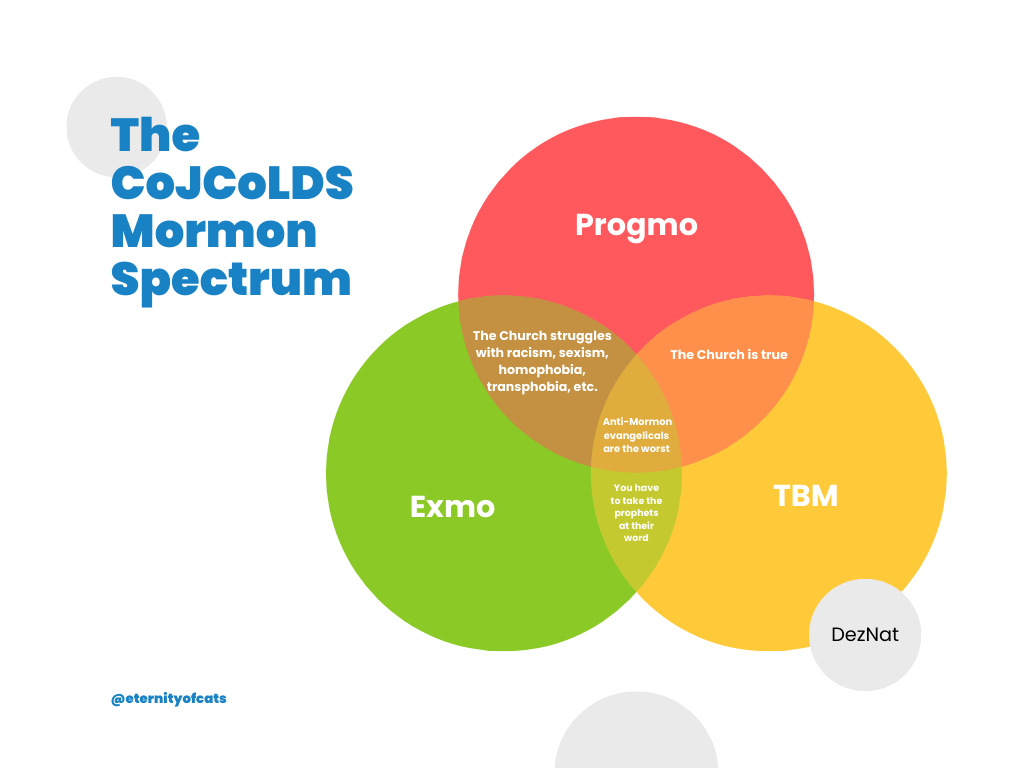
So I don’t like the word “cult” anymore. I probably won’t say something if you’re just venting. I know that it feels good to call the Church a cult and vent your anger at it. But that’s not the only thing that using that word can do. So maybe don’t use it to describe the Church online or anywhere where Christian fundamentalists can hear you.
To me, the BITE model and Hassan’s framework is helpful in understanding your subjective experience. But it’s unscientific and potentially damaging if you use it to describe others’ reality for them.
Please keep that in mind next time you come across a discussion of Mormonism as a cult.
Discover more from Eternity of Cats
Subscribe to get the latest posts sent to your email.
 Eternity of Cats