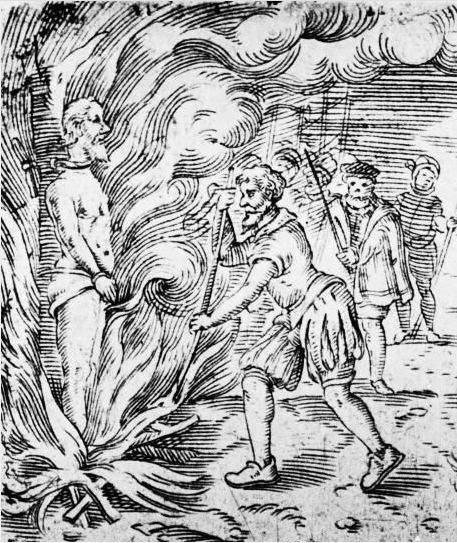
I will burn, but this is a mere incident. We shall continue our discussion in eternity. —Michael Servetus
As part of my research into Unitarian Universalism, I’m watching Long Strange Trip, which is a six-part documentary about the history of Unitarianism, Universalism, and Unitarian Universalism. I recently watched part one, which covers the beginning of the Christian era through the life of Michael Servetus.
The film is set before the formal start of Unitarianism or Universalism, so the focus is on the people and ideas who contributed to the later movements.
The documentary approach is just a white dude telling you things while the setting and background changes, and sometimes they do voiceover while showing pictures of the people involved. So not terrible, but not a particularly engaging format either.
What most caught my interest was the quiet connection to Joseph Smith and Mormonism.
Similar Ideas
I don’t know enough about Joseph Smith’s education to know if he was familiar with Servetus, but Servetus’s ideas are similar to those of Smith and Swedenborg (who also had ideas similar to Joseph Smith’s), and many non-Trinitarian Christian groups draw on Servetus’s ideas.
I was struck by the language Michael Servetus used to describe how Christianity and its preferred Bible translations had become “corrupted.” His words sound a lot like those spoken by Jesus to Joseph Smith in the First Vision narrative and a lot like some traditional LDS teachings on issues with the Bible.
Servetus was also against infant baptism, which he called an invention of the devil. The Book of Mormon is of the same mind.
So at least among nonbelievers, I think it’s fair to say that Servetus, directly or indirectly, influenced the founding of Mormonism.
Mormon Phoenix
Even more fascinating is how Servetus’s life and death are metaphorically and cyclically echoed in LDS history.
Both the Catholic and Protestant authorities were after Servetus, and in 1553, he was burned at the stake at Geneva under the influence of John Calvin, a fellow reformer. Geneva was John Calvin’s scene, and Calvin had told Servetus that he set foot in Geneva, he wouldn’t leave alive. So why Michael Servetus would go there if he didn’t want to die is unclear. The documentary suggests that he felt compelled to debate and engage with Calvin. In fact, Servetus was arrested after attending one of Calvin’s sermons.
I see both John Calvin’s more authoritarian determination and enforcement and Michael Servetus’s indomitable heresy in Mormonism, starting with Joseph Smith.
Perhaps this is not surprising. One of the children of John Calvin’s thoughts is Presbyterianism, and Lucy Mack Smith joined a Presbyterian church. One of the children of Michael Servetus’s ideas is Universalism, and Joseph Smith, Sr., had a universalist background. One of their literal children founded Mormonism.
In any case, Church leadership dons the mantle of Calvin whenever they excommunicate progressive Mormons. These reformers are the Toscanos and Quinns and Andersons of the world, people who continue to publish and to push for change despite the knowledge that the larger institutional powers will probably crush them.
Person after person is silenced, but every time a Servetus burns, another heretic is born from the ashes. In a Church with a founding story about learning from God for yourself, how could this not happen over and over?
Servetus’s death didn’t work out so well for Calvin. Calvin was widely condemned for the execution. Likewise, the Church has increasingly become careful with excommunications because ex-ing someone can invite a lot of blowback and hurt the Church’s reputation.
Things may settle down for a while, but the little phoenix will come back again in a burst of fire and new life. Perhaps this is just how humans work—some people will always break with the status quo. But I find it more satisfying and poetic to think that even if there’s no afterlife, Michael Servetus was right.
Upon being sentenced to death, he said, “I will burn, but this is a mere incident. We shall continue our discussion in eternity.”
There’s something beautiful in the idea that no matter how many times Calvin tries to kill Servetus, the reformer always returns, even if, like a moth, he is drawn to the flame each time.
But Calvin gets weaker each time too.
Servetus’s spirit is alive and well when heretics in any denomination push for heterodoxy, for free thinking and freedom of belief.
Long live that phoenix.
Discover more from Eternity of Cats
Subscribe to get the latest posts sent to your email.
 Eternity of Cats