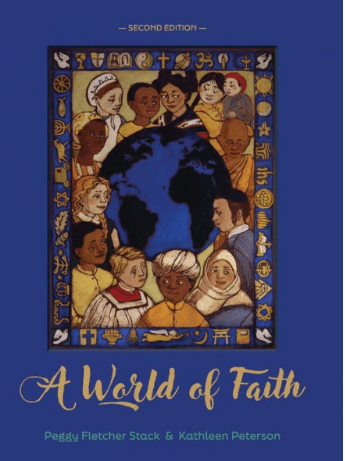
Today we’ll talk about the book A World of Faith, published by Signature Books in 2002. This book is an illustrated guide to the world’s major religions, directed at children ages 8 to 12.
I liked this book, and it looks like I’m in good company—Jimmy Carter also gave this book a positive review.
I rate this book 4.75 stars. (Graphic shows 4.5 stars because it doesn’t do quarter stars.)
Highlights
Each of the (28, I think) religions profiled has a page opposite a beautiful illustration depicting historical people, buildings, and symbols from that religion. Each religion is presented in a light that people of the religion itself would (I would guess) present it in. This approach helps both children and adults find beauty and inspiration in the values of each religion. This focus also allows adults as well as children to see what is important to believers rather than just stereotypes we’ve heard.
Each profile is just one page long, making the 28 religious profiles accessible as well as broad. In addition to various Christian traditions and well-known religions like Islam, the book includes profiles of Hopi and Yoruba traditions, which many readers will not be familiar with.
I was particularly interested to read that Methodist founder John Wesley believed it was possible to become perfect and that Methodists got their name from their methodical, orderly approach to religion. As we know, Joseph Smith was interested in Methodism, and I can definitely see the Methodist influence now.
Drawbacks
This book was written as part of a celebration relating to the 2002 Winter Olympics in Salt Lake City, and as a result, this book is Utah- and US-centric. Most of the sects profiled are Christian traditions, whereas religions that are less popular in the US, like Islam, have one page rather than a page for each branch of the faith. Other traditions, like Wicca, are not included.
In the preface, the authors note their regional focus and state that they use the Hopi and Yoruba as representative of Native American and African traditions, despite many differences among traditions associated with these peoples.
The regional focus makes practical sense, considering the purpose of the book and the length limitations of children’s books. But the Christian-centric focus was slightly irritating to note, since the title is A World of Faith, not US Faiths or A World of Faith in Utah. Kids will definitely get the impression that Christianity is the world’s dominant religion by a larger margin than it actually is.
So if you live in the United States, this book is a good introduction to religions your kid is likely to run into people from, but don’t expect it to be a comprehensive guide to major religious movements.
Notes on UU Portrayals
Another thing that I, as a person attending a Unitarian Universalist church, noted, is that the page on UUs is focused on Unitarianism only. This is a bit odd to me, especially since the book notes that Unitarians and Universalists merged in 1961, and there was UU representation on the interfaith committee that has a greeting at the beginning of the book.
So why did the authors omit half the religious tradition? I’m not sure, but this might be another case of regional bias. The UU church in Salt Lake City is called the First Unitarian Church of Salt Lake City, though most others in Utah call themselves Unitarian Universalist.
A related explanation is that since the merger, Universalist traditions and history have sometimes been sidelined among UUs. So that happening in this book may be a reflection of Unitarian emphasis among UUs, perhaps particularly at a historically Unitarian church in Salt Lake.
Still, the omission of Universalists is odd for a book anchored in Utah, since Mormonism has a lot of Universalist influences (Joseph Smith Sr.’s family was universalist). I assume that UU churches in Utah have a lot of ex-Mormons in their past and present congregations and therefore have more universalist emphasis than UU churches in some other regions.
But whatever. It works. And it’s a good reminder to study other religions deeply and from the perspectives of people from those religions as well as from general sources.
Atheist parents should also note that this book portrays each religion positively. This book fits into my general approach of focusing on tolerance and understanding during the early years, when kids can’t understand nuance as well. Once kids can better understand that people and institutions are complicated, we can go into the harm religion does without making them think that their neighbors and extended family are evil and stupid.
Final rating: 4.75 stars. (Graphic shows 4.5 stars because it doesn’t do quarter stars.)
You can order A World of Faith online. Or maybe you’ll get lucky like I did and find it in a library book sale outside of Utah.
Discover more from Eternity of Cats
Subscribe to get the latest posts sent to your email.
 Eternity of Cats