We’ve talked about whether you should deconstruct free will, contextualized Mormon teachings in the wider discussion of free will, and clarified the differences between supernatural fatalism and determinism.
If you haven’t read the previous posts, then you can find them here:
- Part 1: Should You Deconstruct Free Will?
- Part 2: Contextualizing Agency in Mormonism
- Part 3: Fatalism in a World Without Magic
Now we’re on part four of our free will series, in which we’ll talk about moral responsibility and criminal justice.
CW: discussion of abuse and violent crime
Moral Responsibility
One controversy with determinism is that it affects the idea of moral responsibility. If you couldn’t have chosen differently, then are you really responsible for your actions?
Well, yes, but not in the way we have traditionally thought.
You still make choices that have consequences, and ethics and morality still indicate that you should try to not harm people and should try to make up for harm you do. That doesn’t change.
Gordon Ramsay being Gordon Ramsay.
Determinism just helps us to have less shame when we mess up. We didn’t do something bad because we are bad, we did it because of a number of factors that can be identified and then managed so that we don’t continue to harm others.
Then, instead of beating ourselves up and trying to magically will ourselves into different behavior, we can actually change our behavior, make restitution, and move on.
Free Will and Criminal Justice
The more you believe in free will, the more you will think that crime happens because people choose to do bad things and could have done differently. For example, in Les Miserables, Jean Valjean is harshly punished for stealing bread to feed his nibling. If you’re a compatibilist or a determinist, then you probably don’t think Valjean is a bad person for doing this. You likely believe that he was justified in stealing bread because that’s not as bad as letting a child starve.
But if you’re Javert, then you have a free will view of the world and think that Valjean should have just found another way. There’s no excuse, in Javert’s view, for breaking the law. You’ll starve again unless you learn the meaning of the law, he sings in the musical. Keeping the law and being good, he believes, lead to prosperity. (Of course, this implies that the poor and starving are bad and the rich are morally superior.)
Valjean gets imprisoned for stealing bread and then trying to escape because punishment is supposed to teach him that he needs to be good.
Strict free will theology says that people do bad because they are bad. You punish bad people with prison, hell, etc.
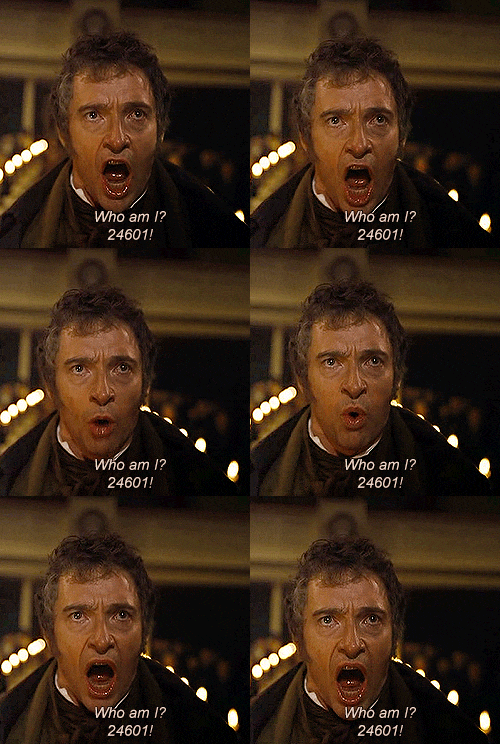
Hugh Jackman as Jean Valjean in Les Miserables.
Valjean, however, knows that he didn’t break the law because he’s a thief. He broke the law because there was no other way to save his sister’s child. The law is cruel and is out of line with reality. I know the meaning of those nineteen years, a slave of the law, he sings.
Authors like Victor Hugo and Charles Dickens called attention to the fact that poverty leads people to commit crimes or engage in antisocial behavior in order to survive. Their books helped people take a more compatibilist view toward criminal justice. Today, we think of throwing someone in debtor’s prison until they pay their debts to be an illogical and inhumane solution. Someone can’t just use free will to magically remove their hardships. How are you supposed to earn money if you’re in jail? Not very easily.
While most people today can easily understand how poverty impacts crime rates, understanding the factors that drive people who commit violent crime, especially rich people who commit violent crime, is a lot harder.
Determinism and Violent Crime
If all our actions are determined by external factors, then evil acts are not caused by evil people. They’re caused by a perfect storm of genetic and environmental factors that lead to tragedy. And determinists think this is true not just with justifiable crimes like stealing food to feed your family but also with the worst crimes you can imagine.
If you watch the Crash Course video on determinism or listen to Sam Harris talk about determinism, you’ll know that brain chemistry, genetics, and even tumors play a role in whether people commit violent crime or not, as do how those genetic factors interact with a person’s history.
While we don’t know everything about why people commit violent crime, determinists believe that people don’t just decide to be evil. They do things for reasons, even though those reasons are often not rational to an outsider and even though those reasons explain rather than justify negative behavior.

Rainn Wilson as Dwight Schrute in The Office (dressed here as a Sith Lord for Halloween).
This shift in perspective has profound implications for our criminal justice system. Determinism indicates that even murderers and child abusers are not evil—they’re unlucky.
Does a lack of free will mean that we have to let people go around committing whatever crimes they want to? Of course not. People still make choices and do things, and those actions impact others. As a society, we still decide together which behaviors we’ll accept and which we will not.
In cases of violent crime, the perpetrator needs to be separated from society for the protection of others, but they need rehabilitation, or in severe cases at least containment, rather than punishment. Just punishing people isn’t likely to change their behavior, and it’s cruel to inflict punishment on someone who’s unlikely rather than evil.
Implications for Abuse Cases
Part of the appeal of this philosophy to me as an abuse survivor is that I understand that it’s very hard to put abusers behind bars. Evidence is often difficult to collect and present, and it’s nearly unheard of for abusers to agree to go to prison. So a lot of abusers are still out there, able to hurt more people. However, I do know abusers who hate themselves for their behavior and whom I am optimistic might admit to what they’ve done if there were a path to rehabilitation that didn’t involve people viewing them as irredeemable monsters.
I also think that part of the problem society has with believing survivors has to do with people’s inability to reconcile their view of the abuser as a person with the idea that abusers are evil and nothing else. Survivors often hear things like, “oh, but he does [good thing]!” or “but he has a family!” in defense of abusers and not holding them accountable. But of course abusers have families. As Glinda says in Wicked, “She had a father. She had a mother. As so many do!”

Ariana Grande as Glinda in Wicked.
If evil acts are caused by people being evil, then it doesn’t make sense for an abuser to be nice and good in some contexts and evil in others. But when we accept that context and external factors affects people’s behavior, we can understand that different people can have hugely different experiences with the same person. That’s not to say that being alone with children makes pedophiles abuse—there are other factors—but it does explain why an adult might not immediately clock a pedophile as such. Sometimes an abuser is nice to someone because they’re manipulating them so that victims won’t be believed, yes, but also abusers are capable of being kind to some people and evil to others. No one is all good or all evil, and that is true even in extreme cases.
If we could get society at large to view perpetrators in a way that is more nuanced without blaming or minimizing the devastating impact their actions have on victims, I think we might address more problems and be more willing to acknowledge the devastating prevalence of abuse.
A More Just Society
To have a healthy society with a deterministic worldview, we need people to evaluate actions in terms of how those actions harm or otherwise affect others, not just in terms of a person’s being good and evil as decided by the Christian god.
With a free will view, it’s easy to focus on intent and thus excuse the harm someone does by saying, “oh, well he meant well,” or “oh, but she’s trying.” If bad actions are caused by evil, and if the people in authority don’t believe that the perpetrator is evil, then we’re likely to think that their actions could not have hurt people very badly. In so doing, we minimize or disregard the suffering of the people they hurt.
Certainly intent can be relevant, but “the road to hell is paved with good intentions” is traditional wisdom for a reason. Most people are trying their best, but good intentions don’t stop us from hurting others.
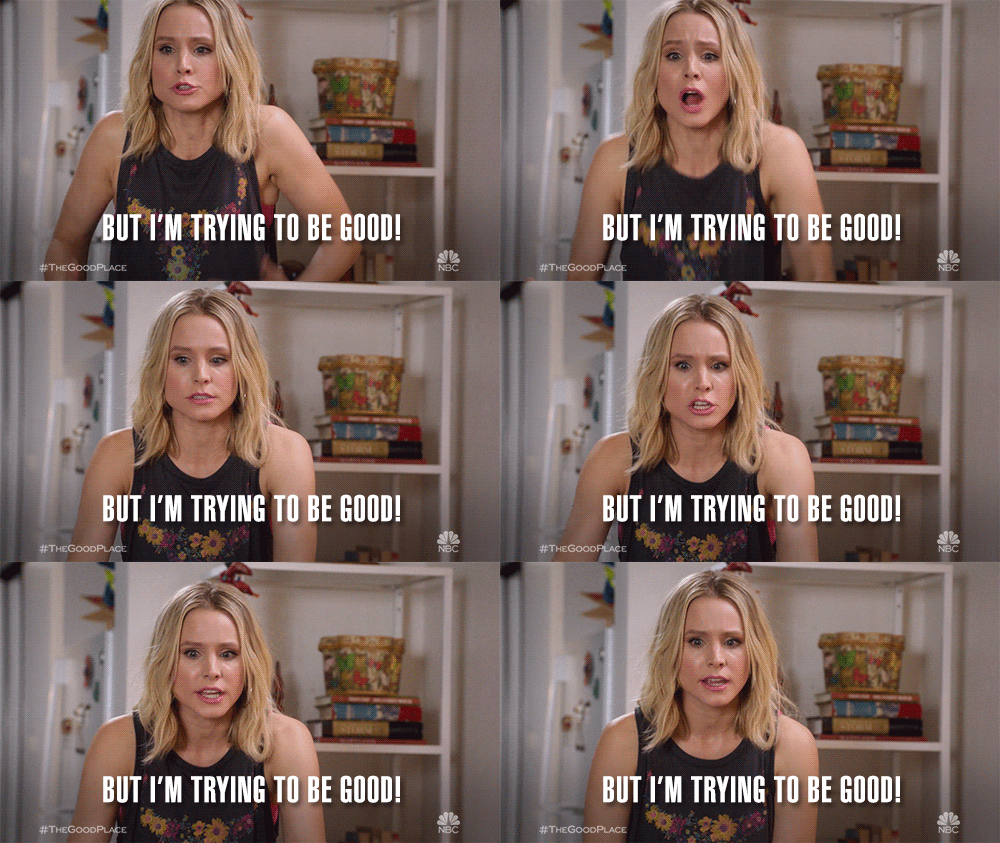
Kristen Bell as Eleanor Shellstrop in The Good Place.
One of the great things about determinism is that it allows us to view others as trying their best without requiring us to minimize the harm that any given person causes.
So yes, with a deterministic worldview, we still respond to people’s choices by imposing consequences. The difference is, we’re not going to label the person as evil, and our emphasis is going to be on addressing the cause of the behavior rather than on punishment. If a person can’t be rehabilitated, we don’t need to release them into the world to go on killing sprees or whatever. But we also don’t need to be cruel to them to teach them a lesson. We just need to contain them for the protection of society.
Those are my thoughts. What are yours? Do you think this approach would improve society? If not, what would your approach be?
In part five, our final post of the series, we’ll talk about determinism, self-improvement, and mental health.
Discover more from Eternity of Cats
Subscribe to get the latest posts sent to your email.
 Eternity of Cats
2 thoughts on “Free Will, Part 4: Moral Responsibility and Criminal Justice”