We look at the world through lenses—the ones in our eyes, in glasses, in binoculars, in microscopes, and in telescopes, to name a few. And whatever lenses you use, you’re going to see different things.
When you’re Mormon, especially if you were raised Mormon, you learn to see the world through the lens of Mormon faith. And in the orthodox Mormon world, you’re not encouraged to use other lenses. You see the world from a Mormon perspective and learn Mormon patterns of interpretation.
If your Mormonism has been more nuanced, you may have learned to use multiple lenses, but you probably also kept prioritizing the Mormon lens for as long as you were a believer. The Mormon lens has probably felt like your eyes themselves. It may still.
Faith transitions don’t automatically come with new training for your eyes. Having the Mormon lens in your collection is not bad, but if you go through the world not believing in Mormonism but still viewing everything primarily through the lens of Mormonism, then you might have some unnecessary problems.
We want to get some more training.
So today we’ll talk about some different ways of interpreting the world, drawing heavily from my study of English literature, to get your brain started on exploring different lenses of interpretation.
Fundamentalist Thinking Vs. Pluralism
Fundamentalist as used in this post is a general term that is not about fundamentalist Mormonism, though people from groups like the FLDS and AUB will have fundamentalist thinking patterns just like people from groups like the LDS will.
When we talk about fundamentalist thinking, we’re talking about literal, strict, unyielding belief, about believing you have the one right way of viewing the world.
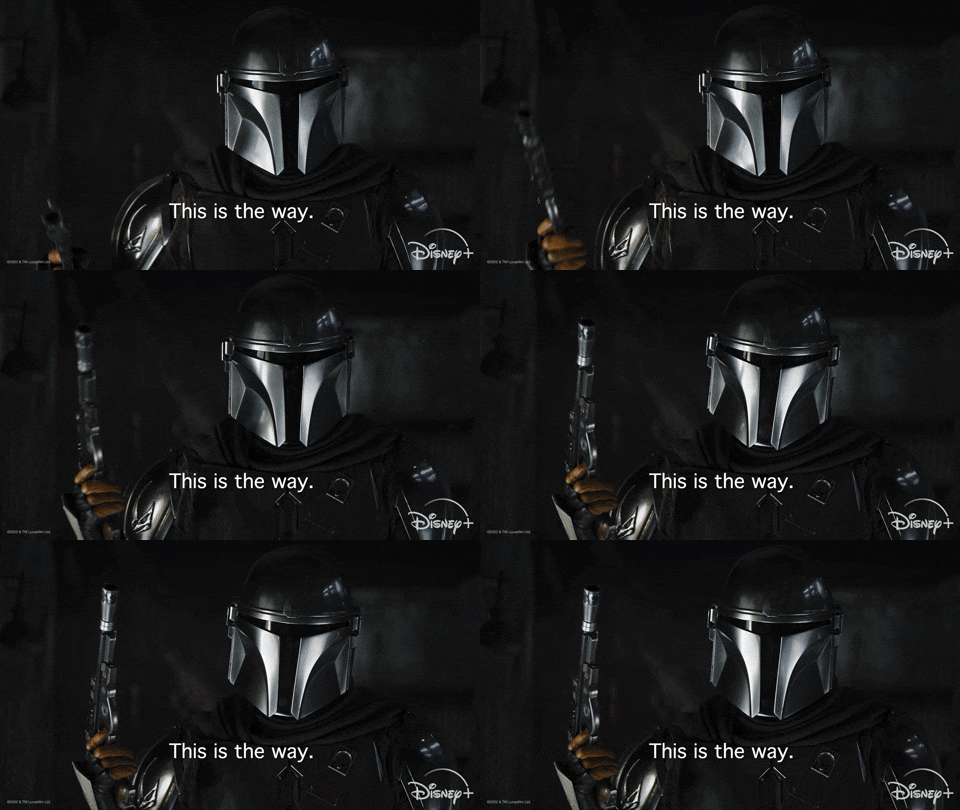
The Mandalorian says “This is the way,” a refrain of his fundamentalist group.
In this respect, anyone can be a fundamentalist. There are many atheist fundamentalists. But here’s the trap of fundamentalist thinking: it makes you think that you know what’s best for other people and may lead you to try to control them.
And we don’t want to do that. Sure, we all think we’re doing what’s best, at least for ourselves. That’s why we’re doing it. But if we want the liberty to be in charge of our own lives, we need to give others the same courtesy.
So we want to develop more nuanced and pluralistic thinking. To do that, we’ll want to learn to see the world through multiple perspectives, without one perspective being our sole means of vision.
Formalism Vs. (Historical) Context
In literary criticism, there’s formalism, which, for the purposes of this post, is analysis that doesn’t take into account context outside of the text itself, like the author’s life or the historical backdrop. Formalist scholars argue(d) that any real meaning should come from the text itself. Given that not everyone with access to the text also has access to background information, this approach is theoretically more egalitarian.
But obviously, formalism has its limitations. If an English teacher were to teach The Grapes of Wrath without ever mentioning the historical context of the Great Depression, then I’d have some questions. And in Mormonism, the historical claims are key to the truth claims.
So why do I bring up formalism, if it’s not the One Way to meaning? Because studying formalism teaches us that context can actually change or create meaning.
For example, LDS temple rituals have a very different meaning when viewed in the historical context of the signs being connected to penalties. If you’re like me and did not know about the penalties until after leaving, then you may have sat around the Celestial Room with friends discussing what the signs could symbolize re: the Holy Spirit, faith, obedience, and repentance.
An interpretation that takes into account historical context and the teaching that the temple endowment is eternal is much more disturbing. In this interpretation, you were agreeing that you’d prefer to die in a horrible manner rather than reveal the signs and tokens you need to pass by the angels and enter heaven, yet you weren’t allowed to know what you were agreeing to.
Obviously, this tends to make ex-Mormons angry, and our anger is valid. Key information was withheld from us, and informed consent is important.

Luke calls Obi-Wan Kenobi on his lame justification for lying to him about what happened to his father.
But the “context can create meaning” lesson goes both ways. Any peace or meaning you previously found in Mormonism may not have been God-given or objective, but it still existed. If your loved ones don’t want to know the history of the endowment, or if they do and choose to interpret the temple rituals without historical context to preserve their own peace, that doesn’t mean their peace is fake. The meaning they find is subjective, like everyone else’s, but it’s theirs to choose, not yours or mine.
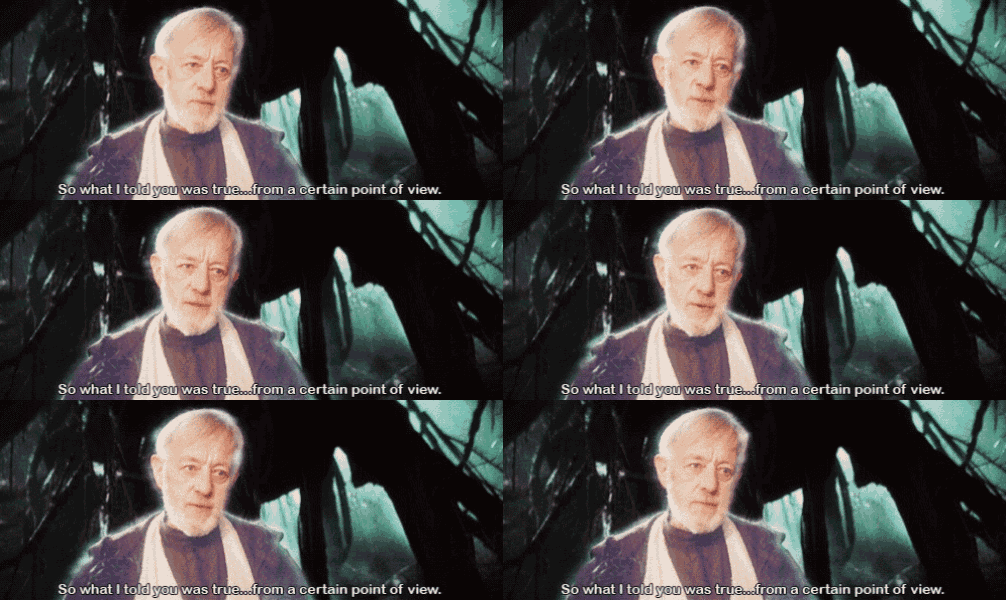
Obi-Wan Kenobi justifies lying to Luke about what happened to Luke’s father.
Using historical context is not the One True Way to find Meaning. Meaning is subjective and involves the interplay of a text itself, the context it was written in, and the context it is read in, including the mind of the reader or listener.
When we acknowledge that context impacts meaning, we can validate our own anger and interpretation while being genuinely happy that our loved ones find peace and meaning in their religious worship. If they feel peace in the temple rather than anxiety, then awesome.
Context also helps us understand members who get mad at us. “You’re taking that out of context!” is a common criticism ex-Mormons (or progressive Mormons) face when we put things into historical context. What a TBM really means when they say this is that we’ve taken something out of the context in which the believer feels good about it. Therefore, in their mind, we must have put things in the wrong context.
I’d argue that the historical context is so key to Mormonism’s truth claims that putting things into historical context is if anything more “correct” than a formalist analysis, but that’s not the point. The point is that members often “come to their own understanding” of the gospel by separating their belief from history. And if they want to do that, then that’s their choice, not mine. Context impacts meaning and so can lead people to different conclusions.
Structuralism Vs. Deconstructionism
With structuralism (again, simplifying for the purposes of this post), we look at common elements in texts and analyze the (allegedly) universal structures as creators of meaning. A common example is the hero’s journey, in which a hero goes through key steps like a call to adventure.
A good thing that comes from structuralism is the ability to find commonalities between different worldviews and analyze systems. A problem with structuralism is that when we try to identify the universal, we necessarily do that from our own points of view and thus superimpose our worldview onto structures to which they don’t apply.
For example, the hero’s journey has been presented as the narrative arc of every character, but it’s not. Feminist critics in particular have criticized the hero’s journey as being too male-centric to apply to many women’s stories.

Barbie asks the other Barbies if they ever think about dying.
This is relevant to faith transitions for a couple reasons. First, since Mormonism was taught to you as universal truth, when you stop believing, your brain will still be comparing everything you see with Mormonism and possibly seeing too much of Mormonism in other systems.
For example, some ex-Mormons are understandably very wary of new communities once they leave Mormonism. However, not all communities function by the same rules. For example, it was an adjustment for me to go to a Unitarian Universalist church and realize that words like faith, religion, covenant, and god mean different things there from what I’d considered the definitions.
Second, structuralism inspired deconstructionism, which you might have heard of. People online often refer to religious deconstruction, and in the context of faith transitions, that means examining your past beliefs and patterns, clearing out what you don’t want, and keeping what you do. When people casually say they’re “deconstructing,” that can mean any sort of faith transition and does not necessarily mean they’ve become atheists.
Deconstructionism in philosophy and literature is related but different—it’s an approach that involves identifying the flaws and contradictions in a system or theory and dismantling it. In literature, this approach does not necessarily mean undermining the value of the text itself, just in analyzing the value of a theory about a text. In philosophy you deconstruct the ideas themselves, thus creating a new philosophical text that can be deconstructed, and so on (until you arrive at nihilism).
We can learn a couple things from deconstructionism. First, from philosophical deconstructionism we learn that you can logically deconstruct any worldview until objective meaning does not exist. (Historically, structuralists were reacting to existentialists and wanted meaning to be objective and universal. Deconstructionism swung the pendulum back.) However, we can also learn from literary deconstructionism (and existentialist philosophers) that you can still find meaning, even if it’s not inherent in the text or in life by itself.
So if you do deconstruct to nihilism, then don’t give up on finding a sense of meaning for yourself. The lesson isn’t that there’s no meaning possible but that there’s no inherent or universal meaning. Life can be worth living even if there’s not one way everyone should live.
Political -Isms
Other common lenses you may gain as you go through your faith transition, if you haven’t already, have to do with analysis from a political perspective. For example, you can analyze a text or an issue from the standpoint of feminism, racism, classism/Marxism, ableism, etc.
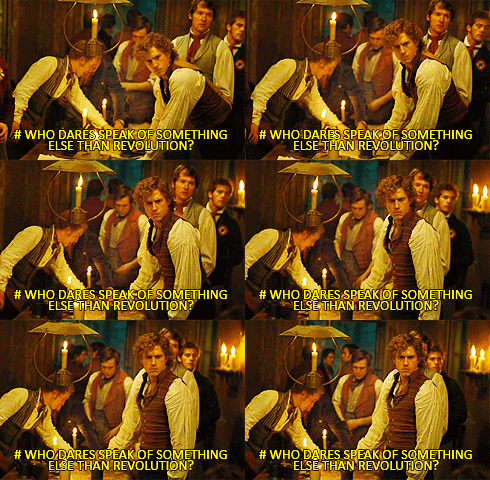
The rich boys of Les Mis try to unite the poor in rising up against their rich oppressors.
I encourage you to learn about these topics and regularly use these lenses. However, as with atheism, you want to keep the caution about fundamentalist thinking in mind. When you analyze a literary text from a point of view such as gender, the point is to interpret everything through that lens and see where that takes you. For literary analysis, this is fine.
In real life, multiple lenses can apply at once, so what seems like a clear-cut case of right and wrong when an issue is viewed from just one lens gets much more complicated when you use multiple lenses (also called being intersectional). You have to use your judgment, not rely on any one theory to spit out an answer for you.
For example, white women often use the lens of feminism to guide their interactions with men, but when interacting with men of color, we also have to consider the impact of anti-Black racism. A white woman who vents about a white man will likely be ignored. A white woman who complains about a Black man could get him killed. That doesn’t mean we can’t address issues of sexism with Black men, but that does mean we white women need to do so very carefully and follow the lead of Black women, who have to see through both lenses, in doing so.
To sum up, the world is complicated, and there are infinite ways to see it. Mormon teachings can give the illusion that there’s always one right way to view an issue and that there’s always a clear right and wrong. Like, literally, some of the lyrics to the hymn “Choose the Right” are “there’s a right and a wrong to every question.”
As you go through your faith transition, you will probably lose your sense of certainty about the world—having it all figured out or knowing the right way to live. But if you acknowledge that things are complicated and that you don’t have it all figured out, then I hope you’ll gain more authentic, rewarding relationships and be free to find the path that will hold the most meaning for you.
Discover more from Eternity of Cats
Subscribe to get the latest posts sent to your email.
 Eternity of Cats