Ex-Mormon Anger, Part 3: Deconstructing Teachings on “Contention”

The Church has gradually gotten better at mental health stuff, but that doesn’t mean that you haven’t still absorbed a lot of unhealthy attitudes about anger from Church teachings.

In Part 1 of this series, we talked about anger, why it’s important, and how to manage it. In Part 2, we deconstructed some LDS teachings on anger. Today, we’ll talk about how LDS teachings about contention can prevent people from developing conflict-resolution skills and ultimately hurt relationships.

Disclaimer: I am a person with a blog, not a medical professional. This information is for educational purposes and is not a replacement for professional counseling.

Demonizing “Contention”

Exhibit A for teachings against contention: The Book of Mormon. At some point, you may have memorized 3 Nephi 11:29, which says:

For verily, verily I say unto you, he that hath the spirit of contention is not of me, but is of the devil, who is the father of contention, and he stirreth up the hearts of men to contend with anger, one with another.

The classical interpretation: All conflict is bad. Anger is bad. Don’t argue.

But conflict is inevitable because any two people will disagree at some point, probably on many points. Whether conflict is managed in a way that is constructive or destructive depends on the conflict-resolution skills of the people involved.

And when you have little to no experience with conflict, you can’t develop good conflict-resolution skills.

Seeing the Consequences

How do these teachings on contention often play out in relationships? Since we’ve been taught that contention and anger are bad, we (ex)Mormons often suppress our anger, consciously or unconsciously avoid discussion of our issues, and let our anger fester into resentment. When our anger and aggression has nowhere to go, we may become passive-aggressive. (Unsurprisingly, Mormons are notorious for passive-aggression.)

How do these teachings often play out within the structures of the Church? People who voice dissent are labeled as angry or even stirred up unto contention by Satan, and so the status quo continues, keeping the powers that be in control. Cue tone-policing of women, people of color, and LGBTQ+ people who try to explain how they’re being harmed.

Often, the person bringing up the issues is calm and speaks with kindness, and yet, because the listener feels uncomfortable, they judge the dissident to be deceived by Satan.

An example where both the systemic and the personal consequences shine is in discussions among women in Relief Society. It’s very common for women to, in the course of commenting during Relief Society lessons, publicly drag their husbands for acting like children. (E.g., “Well, I have five children, if you count my husband, which I do [laughter], and I think . . . ) These women don’t feel allowed to or haven’t been successful in resolving their issues with the husbands themselves, who according to the Church are the patriarchal heads of the family, so complaining among other women is the outlet.

How can you unlearn passive-aggressive communication patterns? Learn conflict-resolution and communication skills. Sometimes we need conflict to move forward.

Differentiating Destructive Versus Constructive Conflict

I’d advise drawing a distinction between destructive and constructive conflict.

Destructive conflict is, well, destructive. It is disrespectful and makes your relationships worse.

One example of destructive conflict is yelling at people on social media to bring them around to your point of view (rude, accomplishes nothing). Another example is when one insults someone or targets their emotional weaknesses or sensitivities during an argument in order to gain the upper hand or make the other person feel bad.

In other words, destructive conflict involves being a jerk.

Constructive conflict, on the other hand, builds understanding and strengthens relationships. It may be uncomfortable in the moment but is necessary for you to move forward. Both parties come at the problem with a humble attitude and stay focused on the issue, without trying to “beat” the other person or make them feel bad. You’re trying to reach a solution together, not subdue the other person. You might need to point out patterns the other person engages in that upset you, but you should do this in a respectful way and be sensitive.

Teaching Kids About Conflict

My tip for mixed-faith families? Make the same distinction between types of conflict, but also use the Mormon terminology of “contention” to describe destructive conflict. That frees kids up to engage in constructive conflict.

For all kids, adults can model healthy conflict resolution and guide kids through their own conflicts when they’re young. Of course, if you don’t have these skills, then you’ll have to gain these yourself first. Counseling can be helpful for this. (Well-run group therapy can allow you to practice conflict-resolution skills with other participants before you try them in your everyday relationships under the guidance of a therapist, but these groups can be hard to find.)

One resource that’s helpful for explaining the concept of constructive conflict to kids is the Bluey episode called “Postman” (or, “Postman and Ground’s Lava”). In this episode, Bluey gets upset with her parents for having a friendly argument about whether the kitchen trash bin should be attached to the back of the cabinet door or not.

Bluey says that “people shouldn’t squabble” and commits to never squabbling again. She makes her dad write a love note to her mom to make up for the trash-bin squabble. Then Bluey tries to deliver the note to her mom while fulfilling an earlier promise to play Ground’s Lava with her sister, Bingo.

As they play, Bluey tries several techniques to prevent all squabbling. First, she tells Bingo that she has to agree with her, Bluey, always. Before long, Bingo decides this doesn’t work for her. Then, Bluey tries to always agree with Bingo, but that doesn’t work for Bluey. Then, they try to agree with each other. All options lead to squabbling.

Eventually, Bluey and Bingo have a squabble and work it out, and Bluey realizes that a squabble can resolve issues and make you feel good.

Avoiding Patriarchal Patterns

Did you notice that the immature “you need to always agree with me” approach that Bluey tries with Bingo is something the Church has relied on with women? I did.

In traditional LDS thought, you’re not supposed to have contention/conflict, including in a marriage. But disagreements are inevitable, and the solution the patriarchy has decreed is that the woman needs to obey (or “hearken to”) the man (unless he wants something contrary to God’s commandments).

Fortunately, many LDS couples ignore that temple covenant and learn communication skills, but in many marriages, the woman repeatedly has to swallow her truth and inevitably becomes resentful.

Note that if a person has very little power, then they’re more likely to have to resort to passive-aggression or manipulation to get their needs met. Misogyny often claims these are natural female behaviors, but please note that they are survival strategies developed in response to patriarchy.

If you have learned these strategies, you can unlearn them and replace them with boundaries and conflict resolution.

Don’t continue this patriarchal pattern post-Mormonism! It’s a recipe for resentment and bad marriages.

Instead, learn how to communicate effectively and build conflict-resolution skills.

Ex-Mormon Anger, Part 2: LDS Teachings on Anger

In Part 1, we talked about what anger is and why it is important. In Part 2, we’re going to deconstruct some LDS teachings on anger. (We’ll deal with teachings on “contention” specifically in Part 3.)

Why are we doing this? Because you probably have false ideas in your head that are holding you back, whether or not you’re consciously aware of them.

For orthodox members, anger can be overwhelming, disturbing, incomprehensible, and possibly Satanic. So amid your faith transition, your anger may make you feel out of control.

I hope this will help. After you read this, you may want to go back to Part 1 and review what healthy anger is.

I’m also going to present some more nuanced interpretations I learned as a progmo (progressive Mormon) to help you out if your family is mixed-faith. In other words, you can use these progmo views to help them develop social-emotional skills without undermining the religious beliefs of the other parent or of the kids themselves.

Disclaimer: I am a person with a blog, not a medical professional. This information is for educational purposes and is not a replacement for professional counseling.

Demonizing Anger

As you might know, Mormonism is against anger in general. Exhibit A comes from the Book of Mormon.

As Lynn Robbins notes in the talk “Agency and Anger,” both the Joseph Smith Translation and the Book of Mormon change Matthew 5:22 from “whosoever is angry with his brother without a cause shall be in danger of the judgment” to just “whosoever is angry with his brother shall be in danger of the judgment” (emphasis added).

In the cited talk, Robbins preaches multiple times against “becoming angry” and advises listeners that, “Becoming angry is a conscious choice, a decision; therefore, we can make the choice not to become angry. We choose!” He encourages members to do away with anger and resolve right then to never become angry again.

Yoda also did not understand emotions very well.

LDS leaders have drawn a straight line between anger and the worst crimes. (I’ll talk about how right or wrong they are in a minute.) In “Agency and Anger,” Robbins calls anger a trigger for verbal and emotional abuse and says that physical abuse is “anger gone berserk.”

Likewise, Gordon Hinckley, in his talk “Slow to Anger,” says:

It is when we become angry that we get into trouble. The road rage that affects our highways is a hateful expression of anger. I dare say that most of the inmates of our prisons are there because they did something when they were angry. In their wrath they swore, they lost control of themselves, and terrible things followed, even murder. There were moments of offense followed by years of regret.

In that same talk, Hinckley also says that divorce is “in most cases the bitter fruit of anger.”

Now, that’s a lot to unpack. First, let’s just note that you might be afraid to feel anger because you’ve been taught that you could lose control and abuse or murder somebody.

So lots of fear getting you to suppress anger there. But before we dig in to the claims about social ills, we need to figure out what LDS leaders mean when they say “anger.”

Feeling Anger Versus Doing Violence

LDS leaders have gotten better at this over time, but until recently, they haven’t differentiated with feeling anger and being violent. For example, with both “Agency and Anger” and “Slow to Anger,” you can argue, based on the texts, that the speakers are talking about anger as a feeling or that they are referring to doing violence.

We’ll look at both interpretations here.

“Becoming Angry” As “Feeling Anger”

The more traditional, orthodox interpretation is to interpret “becoming angry” as a reference to feeling anger or acting out of anger. Both are included. And this seems to be what Lynn Robbins is saying in “Agency and Anger” when he says:

Anger is a yielding to Satan’s influence by surrendering our self-control. It is the thought-sin that leads to hostile feelings or behavior. It is the detonator of road rage on the freeway, flare-ups in the sports arena, and domestic violence in homes.

Referring to anger as a “thought-sin” makes it fairly clear that he is saying that feeling anger is a slippery slope to violence.

And I’ll refer you again to this Hinckley quote from “Slow to Anger,” which implies the same thing, that feeling anger leads to a loss of control and sometimes to crime:

It is when we become angry that we get into trouble. The road rage that affects our highways is a hateful expression of anger. I dare say that most of the inmates of our prisons are there because they did something when they were angry. In their wrath they swore, they lost control of themselves, and terrible things followed, even murder. There were moments of offense followed by years of regret.

The attitude that people often form based on these kinds of teachings is that feeling anger, while not always disastrous, is dangerous and should therefore be avoided, just to be safe.

Another point toward “feeling anger” being included as a sin is the fact that leaders don’t clearly explain what they mean, perhaps because they don’t understand the distinction themselves.

“Becoming Angry” As “Doing Violence”

You can also argue that when LDS leaders talk about “becoming angry,” they often are trying to say “don’t be violent.”

In “Agency and Anger,” Robbins quotes William Wilbank to illustrate that anger is a choice and can be controlled:

To those who say, “But I can’t help myself,” author William Wilbanks responds: “Nonsense.”

“Aggression, … suppressing the anger, talking about it, screaming and yelling,” are all learned strategies in dealing with anger. “We choose the one that has proved effective for us in the past. Ever notice how seldom we lose control when frustrated by our boss, but how often we do when annoyed by friends or family?” (“The New Obscenity,” Reader’s Digest, Dec. 1988, 24; emphasis added).

Wilbanks’s quote refers to actions and anger management strategies. Further, Robbins refers to the bits of the Family Proclamation that condemn abuse several times throughout the talk, including at the beginning and the end. So while I do think he’s clear on calling anger a “thought-sin,” it does seem like the “anger” he’s trying to address and prevent is ultimately “violence and abuse.”

Despite scary quotes like that “anger sometimes leads to murder” bit, Gordon Hinckley makes a bit more room for anger as a feeling, and sometimes even a motivator for action, being allowed. In “Slow to Anger” he cites Jesus’s cleansing the temple as an action manifesting controlled anger, and he quotes extensively from the hymn “School Thy Feelings,” which includes these lyrics:

School thy feelings, O my brother;

Train thy warm, impulsive soul.

Do not its emotions smother,

But let wisdom’s voice control.

I’m also amused to see that he contradicts Robbins. While Robbins says, “nor can becoming angry be justified” in “Agency and Anger,” Gordon Hinckley, in “Slow to Anger,” says, “anger may be justified in some circumstances.” What Hinckley condemns unequivocally is uncontrolled anger.

Unpacking the Causes of Social Ills

Now that we’ve addressed the lack of clarity around the meaning of the word “anger,” let’s return to the scary claims about anger leading to everything bad happening.

“That is the sound of a thousand terrible things heading this way.”

While crimes of passion exist, you’re unlikely to black out due to rage and wake up having committed unspeakable crimes. If you have problems controlling your anger, then by all means, work on your emotional regulation and anger management skills! But I don’t think that poor anger management is the cause of most crime.

Next, let’s address Hinckley’s claim that “most of the inmates of our prisons are there because they did something when they were angry.” The talk from which this quote comes was given in 2007 in the United States, where a massive amount of imprisonment has been of Black people who are imprisoned for non-violent drug offenses that white people also commit but aren’t punished for. Not sure what that has to do with uncontrolled anger.

More broadly, much of crime around the world is fueled by, in the words of John Green, systemic disenfranchisement, poverty, and lack of access to job opportunities and education (here’s the more-fun Songified version). Gangs, which commit a lot of serious crime, thrive in these conditions. And what about theft? Would it disappear entirely if there were no poverty? No. But a lot of it would be gone, and addressing poverty would do more than getting rid of anger.

Other important factors to consider include access to guns and power structures such as patriarchy.

Divorce can be caused by many things, but anger tends to be a side effect of the conflicts that lead to divorce, not the cause in and of itself. One partner never doing chores, having an affair, or abusing the other will definitely cause anger, but calling the cause of the divorce “anger” is incredibly invalidating to divorced people and their right to be respected and supported by their life partners.

And that brings us to abuse.

Identifying Causes of Abuse

Abuse is perpetuated by people at all socioeconomic levels and can be exacerbated by poverty but is not caused by it. Specifically, we’re going to talk about domestic violence and gender-based violence, since that is a major target of Hinckley’s and Robbins’s preaching.

To be clear, I’m glad they’re preaching against abuse! Abuse is bad, and people should not abuse other people! The problem is that the preaching isn’t accurate enough to be very helpful. See, abuse is generally not caused by people failing to control their anger.

Abusers often cite anger or someone “making them angry” as their excuse. And Robbins notes that point and comes very close to understanding it in “Agency and Anger” when he quotes William Wilbank to illustrate that anger is a choice and can be controlled (see the quote above).

Robbins rightfully identifies that since these men are not losing control with people like their bosses (people with power over them) they are clearly making a choice to express themselves in an abusive way with their family members.

His problem is that he doesn’t interrogate why these men are willfully abusing women and children. He seems to think that their problem is giving place to anger in the first place and then losing control, as though anger can only be controlled in the early stages.

Anakin: an abuser and murderer who was definitely in control of himself despite using his anger for evil.

And this is just wrong. We have tried to reform abusers who have been convicted of battering their wives through teaching anger management and assertiveness. And it hasn’t worked, because that is not the problem. Anger and violence are tools abusers use to serve a specific purpose: controlling women and children.

Why do they do that? Because they feel entitled to control women and children. Why do they feel entitled? Lots of reasons, but when it comes to Mormon men who abuse their families, the explicit patriarchal structure of families and the Church definitely fuels entitled attitudes in many men.

For example, canonized modern scripture describes women and children as the property of men. Thankfully, some patriarchal wording has been removed, but temple covenants used to require women to obey their husbands and give themselves to them, while men made no equivalent promises.

And still, there’s been no clarity around whether those covenants are still in force for people who made them. Are women who had to give themselves to their husbands their own people again, since that part is no longer in the wording of the covenant, or does the switch not apply to people who already made the covenants? Or do all wives still belong to their husbands, as indicated in all of scripture and Church history, only we don’t say that part out loud anymore?

If LDS leaders are serious about wanting to stop violence against women and children, they need to do more than listen to men who say “she made me so angry that I abused her” and then preach a sermon on how that’s not a good excuse. Abusers are aware of what they’re doing. LDS leaders are letting them get away with it.

I’ll get off my soapbox now, but the point is, sure, anger can be involved in abuse, but you can manage and express anger in healthy ways without committing crimes. Hinckley and Robbins have no idea what they’re talking about.

Managing Anger and Teaching Kids About It

On a brighter note, teaching strategies for anger management and emotional regulation is a great thing to do with kids.

If you are in a mixed-faith marriage and need to find a way to teach about anger that works with Mormonism, then connecting Church teachings on anger to bad things done with unrestrained anger is how I’d go about that.

And probably I’d avoid using either of the talks I’ve cited in this post to teach your kids. So much terrible information in there.

So what can you teach them? Anger is useful when it’s helping you identify when you need to set boundaries. Channel this kind of anger into assertive action.

How do you explain the differences between passivity, assertiveness, and aggression or violence?

As I was told in therapy, imagine that someone steps on your foot.

It is not bad for you to say, “Hey, get off my foot.” If the person will not get off your foot, you would not be out of line to push them off your foot. Those are both examples of being appropriately assertive.

If you just let the person keep standing on your foot and don’t say anything, then you’re being too passive. They’re hurting you, and you matter too.

If you scream at the person and beat them with a baseball bat for standing on your foot, then you’re being too violent or aggressive.

The semantic distinction many people draw with anger is to tell people to be assertive, not passive or aggressive.

Note, however, that if you use the word “aggressive” in explaining anger management to a child, then you need to explain that “aggressive” often means something different in sports scenarios. Otherwise, you might casually shout “be aggressive” and then have a child who is very confused about why you’re upset that they slide-tackled another kid.

For more ideas for teachings kids about anger, see Part 1.

Tune in next time, when we’ll talk about LDS teachings on contention.

Ex-Mormon Anger, Part 1: All About Anger

Anger is probably the dominant emotion for most ex-Mormons during their faith transition. You probably feel betrayed upon learning things the Church hid, enraged about the harm the Church has done and is doing, and furious about the lies Church leaders have told.

But you also may feel like anger is bad and have no idea how to handle it. So let’s talk anger: what psychology says about it and some basic tips for managing anger.

As always, remember that I am a blogger, not a therapist. This information is for educational purposes and is not a replacement for therapy or medical treatment.

Anger As a Primary Emotion

Anger can be a primary or a secondary emotion. A primary emotion is a basic, instinctual one that serves an important purpose. That’s right: feeling anger isn’t a flaw. Anger is a signal, and you need it. A great portrayal of this concept is in the movie Inside Out, in which Anger is a core member of Riley’s emotions team. He’s introduced as an emotion that cares deeply about things being fair.

via GIPHY

Anger tells you when your brain thinks that you’re being harmed or treated unfairly. Is your brain always right about this? No. Feelings are information but not facts. But when you feel anger, it’s worth looking at whether you’re being harmed and what you can do about it.

Anger As a Secondary Emotion

Anger can also be a secondary emotion, which is an emotion you have in response to another emotion. So anger can cover up the emotion that is at the root of whatever issue you’re dealing with.

So it wouldn’t be unusual if, to avoid feeling helplessness, guilt, or fear, you just get really angry. This process can happen so fast and unconsciously that it’s hard to realize that that’s what you’re doing.

This is true for everyone, but with anger, this is particularly true for men and people who are AMAB. Men face a lot of cultural pressure (in most cultures in the world) to not feel emotions like fear, helplessness, or guilt, but anger is often considered more masculine and therefore more allowable.

The Importance of Feeling Anger

Anger can be hard to manage, and, if you’ve grown up thinking contention is of the devil, then you might have a hard time feeling it at all. Instead, you may have feelings such as guilt, anxiety, or shame that keep you from embracing your anger.

This is particularly true if you are a woman or a person who was AFAB. Anger is, in most cultures, not considered feminine, though feminists are working on helping women to use the power of their anger for good.

This is an even deeper issue if you’re a woman of color. When you’ve expressed anger, you’ve likely received more hostile responses and given a label such as the “angry Black woman.”

And if you’re a man of color, you might also be particularly careful around anger because, especially for Black and Indigenous men in the United States, you’re likely already deemed dangerous just for existing. Displaying anger can be dangerous for men of color.

If you have repressed anger, then learning to process anger can help your health, relationships, and happiness. Repressing anger can keep you from identifying harm and protecting yourself. Repressed anger can manifest as passive-aggression and self-righteousness, and it can impact your health, causing or contributing to depression, anxiety, paranoia, chronic pain, high blood pressure, and more.

Tips for Managing Anger: Self-Awareness

If you’re not used to being aware of and responsive to your feelings, then you may want to start by sitting and focusing inward. What you feel, how and where that feeling sits in your body, and what thoughts or experiences your feelings are stemming from. Deep breathing can be helpful here, both for focusing inward and for managing feelings of rage.

via GIPHY

When I first started being able to feel anger, I was like Giselle in Enchanted. I was so excited that I’d done it that I was no longer angry. Managing anger can take practice.

Tips for Managing Anger: Talking It Out

Venting your rage to a sympathetic ear can be very helpful. This is a big part of why ex-Mormon forums like r/exmormon (and the private Exmo women’s group), ex-Mormon Twitter and Threads, ex-Mormon Instagram, and communities around exmo podcasts and vlogs exist. We like to support each other!

Talking to a therapist can also be a huge help. A trained and licensed counselor can help you to process your anger in privacy with skill and context that we internet randos can’t. If you can find a therapist who specializes in religious trauma or used to belong to a fundamentalist religion, even better. (Sometimes therapists who don’t know much about fundamentalist religions come across as less than validating.)

If you have a significant other, friend, or family member who is also ex-Mormon or is willing to listen, then that’s great too!

Journaling (if Mormonism hasn’t turned you off of it) can also be very helpful.

As long as you’re in a space where you’re not freaking out children or verbally abusing anyone, then you can let loose. Curse, vent, rant, scream, and say whatever it is you need to say.

You can say every bad thing about the LDS Church and God that has ever come into your head. Rant about your family or your friends or your singles-ward bishop. (If they’re not there, then cursing them is not verbally abusing them. And if no one tells them what you said, then your words can’t hurt them. Say what makes you feel better.)

If something so dramatic doesn’t feel good to you, then experiment with what does feel helpful. For example, when I’m angry with someone, what makes me feel better doesn’t tend to be cursing or calling them a monster or a fascist. Instead, I like to think up the most devastating insult I can that is still definitely true. When I was still a believer, I liked to pick scriptures that insulted the person for me.

Tips for Managing Anger: Physical Acts

Many people need to express their anger physically. If this is you (or you’re not sure whether this could help you), then just make sure that you’re safe and not hurting anyone. Don’t assault anyone, physically or sexually, and don’t destroy property that isn’t yours.

You may find it helpful to run, punch and kick a punching bag, or hit a pillow against a wall. You can use your imagination; just remember safety standards. For example, I read that breaking glass helps some people, so I once tried breaking glass jars with a hammer, with those jars being inside a box to contain the glass, and I wore safety goggles.

Again, be careful who you’re around when you do this. Your toddler doesn’t need to see you throwing darts at a picture of the apostles.

Managing Anger With Children Around

Privacy can be very helpful for being able to process new emotions, especially if you fear them. And your privacy can be very helpful to your children, since young children especially are prone to assuming that whatever you’re angry about is their fault. You don’t want to freak kids out or make them feel like they’re in danger or that you’re out of control.

Still, you might feel out of control, and depending on your childcare situation and state of emotional overwhelm, you may have little choice but to process your emotions in front of small children to some degree.

Also important to remember is that if your kids are older (pre-teens, teens, or adults) and/or have had traumatic experiences, then seeing that you have anger too can also be helpful to them in their own faith transition and recovery. We want to model healthy anger management, not pretend like we never experience human emotions.

A good general rule is that the younger the child is, the more you should be careful about trauma-dumping on them. Older kids might like to know that you are also struggling with patriarchy, racism, etc., but how much detail they want is going to vary. You’ll have to judge how much is too much for your kid. Fortunately, if your kid is old enough for that, they’re also old enough that you can ask them to tell you if you’ve gone from trying to not hide your humanity to burdening them.

Things You Can Do With Kids

Fortunately, kids today have a lot more resources for social-emotional development. If you have littles, then you could watch shows like Ms. Rachel’s Songs for Littles (choosing episode titles that reference emotions and/or anger) and Bluey (specifically, “Stickbird” and “Sheepdog”) with them and use these episodes to help you explain what you’re going through.

Ms. Rachel teaches kids that emotions are normal and don’t last forever, and she shows kids how to take belly breaths to help them when they’re angry. This is a good strategy for adults too. You can tell your child something like, “[Mommy] feels upset right now. I’m not mad at you, and you don’t need to worry about it. [Mommy] loves you and will feel better later. But right now, Mommy needs to [take a lot of belly breaths / journal / exercise / take a break].”

For vocal venting, you can show your child how to scream into a pillow. They will probably love that. Older children may appreciate being able to curse in front of or vent to you. In this case, you may be able to demonstrate a bit; that can help your child feel safe to vent. Just don’t make your kid your therapist.

For physical coping skills, exercise, including punching and kicking a punching bag, is probably a solid choice. Beyond that, you’ll have to judge based on how much your kid needs to find ways to vent and how much they understand about what you’re going through. Communicate with your kid, make sure they are safe and feel safe, and help them get what they need to vent their own anger.

Boundaries

A lot of ex-Mormon anger just needs to be let out, and you kind of just have to let it burn until it burns out. However, if you keep having new anger come up, then it’s time to look at your boundaries.

We will talk about boundaries (what they are and how to set them) another time, but for now, we’ll say that boundaries are personal policies that protect you. When you don’t have adequate boundaries, you keep being harmed, and so new anger is born. If the same things keep angering you, then boundaries may be able to help.

For example, if your parents keep sending you conference talks, then you can decide that you’re going to delete those emails without reading them. You can’t stop your parents from sending the emails, but you can tell them that if they don’t stop, you will delete their emails and thus not see or respond to any personal messages that might be included. If Church-related emails are not clearly marked, then all their emails might get deleted.

Anger As Energy

Of course, boundaries cannot prevent all problems. For example, you can’t use boundaries to totally escape patriarchy or white supremacy. You will probably still hear about the Church through family and because the LDS community might still be your community. Sometimes, things are going to make you angry.

This is normal, but this is also where we can use anger as empowering energy. Anger can drive us toward greater justice in the world. We can do something with our anger and help to make the world better.

In Ex-Mormon Anger, Part 2, we’ll talk about Mormon teachings about anger and how you can deconstruct them and keep only what makes sense. In Part 3, we’ll do the same for teachings about contention.

In the meantime—how do you manage your anger? What are your go-to strategies?

Book Review: A World of Faith, by Peggy Fletcher Stack and Kathleen Peterson

Today we’ll talk about the book A World of Faith, published by Signature Books in 2002. This book is an illustrated guide to the world’s major religions, directed at children ages 8 to 12.

I liked this book, and it looks like I’m in good company—Jimmy Carter also gave this book a positive review.

I rate this book 4.75 stars. (Graphic shows 4.5 stars because it doesn’t do quarter stars.)

Rating: 4.5 out of 5.

Highlights

Each of the (28, I think) religions profiled has a page opposite a beautiful illustration depicting historical people, buildings, and symbols from that religion. Each religion is presented in a light that people of the religion itself would (I would guess) present it in. This approach helps both children and adults find beauty and inspiration in the values of each religion. This focus also allows adults as well as children to see what is important to believers rather than just stereotypes we’ve heard.

Each profile is just one page long, making the 28 religious profiles accessible as well as broad. In addition to various Christian traditions and well-known religions like Islam, the book includes profiles of Hopi and Yoruba traditions, which many readers will not be familiar with.

I was particularly interested to read that Methodist founder John Wesley believed it was possible to become perfect and that Methodists got their name from their methodical, orderly approach to religion. As we know, Joseph Smith was interested in Methodism, and I can definitely see the Methodist influence now.

Drawbacks

This book was written as part of a celebration relating to the 2002 Winter Olympics in Salt Lake City, and as a result, this book is Utah- and US-centric. Most of the sects profiled are Christian traditions, whereas religions that are less popular in the US, like Islam, have one page rather than a page for each branch of the faith. Other traditions, like Wicca, are not included.

In the preface, the authors note their regional focus and state that they use the Hopi and Yoruba as representative of Native American and African traditions, despite many differences among traditions associated with these peoples.

The regional focus makes practical sense, considering the purpose of the book and the length limitations of children’s books. But the Christian-centric focus was slightly irritating to note, since the title is A World of Faith, not US Faiths or A World of Faith in Utah. Kids will definitely get the impression that Christianity is the world’s dominant religion by a larger margin than it actually is.

So if you live in the United States, this book is a good introduction to religions your kid is likely to run into people from, but don’t expect it to be a comprehensive guide to major religious movements.

Notes on UU Portrayals

Another thing that I, as a person attending a Unitarian Universalist church, noted, is that the page on UUs is focused on Unitarianism only. This is a bit odd to me, especially since the book notes that Unitarians and Universalists merged in 1961, and there was UU representation on the interfaith committee that has a greeting at the beginning of the book.

So why did the authors omit half the religious tradition? I’m not sure, but this might be another case of regional bias. The UU church in Salt Lake City is called the First Unitarian Church of Salt Lake City, though most others in Utah call themselves Unitarian Universalist.

A related explanation is that since the merger, Universalist traditions and history have sometimes been sidelined among UUs. So that happening in this book may be a reflection of Unitarian emphasis among UUs, perhaps particularly at a historically Unitarian church in Salt Lake.

Still, the omission of Universalists is odd for a book anchored in Utah, since Mormonism has a lot of Universalist influences (Joseph Smith Sr.’s family was universalist). I assume that UU churches in Utah have a lot of ex-Mormons in their past and present congregations and therefore have more universalist emphasis than UU churches in some other regions.

But whatever. It works. And it’s a good reminder to study other religions deeply and from the perspectives of people from those religions as well as from general sources.

Atheist parents should also note that this book portrays each religion positively. This book fits into my general approach of focusing on tolerance and understanding during the early years, when kids can’t understand nuance as well. Once kids can better understand that people and institutions are complicated, we can go into the harm religion does without making them think that their neighbors and extended family are evil and stupid.

Final rating: 4.75 stars. (Graphic shows 4.5 stars because it doesn’t do quarter stars.)

Rating: 4.5 out of 5.

You can order A World of Faith online. Or maybe you’ll get lucky like I did and find it in a library book sale outside of Utah.

First Things: Faith-Transition Grief for Ex-Mormons

Leaving the Church, mentally or physically, involves a grieving process.

This post will talk about grief through the lens of the ex-Mormon experience. We’ll talk about the five “stages” of grief, which are five emotional reactions you may have (in any order) as you move through your grief and into a new, fulfilling life.

I’m not a therapist or any sort of qualified person, so this information is intended for educational purposes, to be taken with salt and critical thinking. Remember that blog posts are not substitutes for counseling or medical care.

What Grief Does and Doesn’t Mean

Grieving does not mean that you wish you believed again (though it might).

Grieving does not mean that you’re doing the wrong thing. (If you feel newly empowered to pillage, rape, or murder, then maybe try to make Mormonism work for you, but otherwise, you’ll probably be fine.)

Grieving does not mean you would be happier in the Church. (I can’t tell you how you’re going to feel, but most people I’ve talked to are at least as happy after a transition phase.)

Grieving does not mean you will never feel better. (I imagine you will.)

Grief during a faith transition just means you feel loss. And that makes sense. The Church is likely an institution you’ve been devoted to and that was central to your identity, relationships, and worldview.

Now all that is changing.

I hope that with time, you come to view the death of your existing faith as a spiritual rebirth. But, whatever you call it, the transition is hard. But things can get easier. One way to ease the transition is to know the basics about grief and the emotions that go with it.

Denial

Denial is your brain protecting you from realities that would be uncomfortable (or worse) for you to process. It’s hard to stop yourself from being in denial because it’s an unconscious process.

Denial gets dangerous when it keeps you from acknowledging what is hurting you or others. For example, people often respond with denial when something terrible happens. Things that you (or members of your family) may have been in denial about include not being straight, the Church being “true,” or being abused.

If you’ve been the person whose reality wasn’t accepted, then you know how painful denial can be. Your family may not accept that you’re leaving the Church forever, that you’re gay, or that you were abused.

It’s rough.

To some extent, we all subject each other to denial because we all force each other to confront uncomfortable realities. You’ve probably also hurt other people because of your denial. When you realize you’ve hurt others, especially if the person is your child or if you’ve messed up in a big way, the shame can be paralyzing.

So first, be gentle with yourself. Denial is your brain trying to protect you. And you can be accountable, apologize, and seek reconciliation when appropriate. You can also not reconcile with people or institutions that have hurt you when appropriate.

Still, we want to minimize the instances in which we stay in denial and hurt ourselves and others. How do we do this? Here are the highlights.

We need to get better at managing uncomfortable feelings, especially helplessness, guilt, sadness, and shame. We need to be able to sit with these negative emotions instead of stuffing them down or away where we don’t have to feel overwhelmed by them.

We need to get better at talking to others about their and our feelings and being empathetic. We need to prioritize the well-being of others.

And we need to learn to be accountable and make restitution for our actions without drowning in shame. This means working through the perfectionism that tells us that our mistakes make us worthless. It’s not true, and those attitudes incentivize our brains to keep us in denial rather than accountable for our actions.

It’s hard to learn to do all this, but over time, you can. (Professional counseling can be very helpful.)

Anger

The Book of Mormon says that contention is of the devil (3 Nephi 11:29), and you’ve probably heard a lot of General Authority quotes against anger (this talk is a good example). If you’re a woman or AFAB (assigned female at birth) person, you’ve also faced intense cultural pressure to never be angry. This can make it very hard for ex-Mormons to even feel their anger, let alone process it in a healthy way.

For now, know that anger is a primary emotion (meaning a basic and essential one) that tells you when (your brain believes) someone is hurting you. Like pain can indicate that you need medical attention, anger can indicate that you need self-care and improved boundaries or to get out of a harmful situation.

Anger can also be a secondary emotion and can function as a way to cover up feeling emotions like fear and helplessness. This is especially relevant for men and AMAB (assigned male at birth) people, who have been socialized to feel shame in the face of fear and helplessness. Anger can be a way to avoid those less-acceptable emotions.

You probably have a ton of anger about the Church, and you’ll need to express it appropriately and let it burn out. This is where a lot of ex-Mormons make anonymous social media accounts so that they can rant about the Church with others who have left without offending their families. (Note that arguing with believing Mormons is unlikely to change their minds or to do anything productive.)

Whatever way you express anger, remember that you need to do so without hurting others or yourself and without destroying property that isn’t yours. Don’t assault people—verbally, physically, or sexually.

If you have trouble managing your anger, seek help from a counselor or call a helpline. (Even if you don’t have a mental illness, overwhelming rage is an issue a counselor or a mental illness helpline can help you with.)

Also be careful around children. Modeling healthy anger management, especially if your children are older and also have rage to vent, can be a great thing. But remember that kids, especially young children, will be prone to thinking your rage is their fault, so be cautious and mindful in venting in front of them.

Bargaining

This may look like continuing to go to church when you’re mentally out (often called PIMO, or “physically in, mentally out”), trying to figure out ways to put your faith back together, or beating yourself up for not figuring out the truth sooner.

Many people go through a “progmo” phase before leaving the Church entirely, and depending on your point of view, that could be a form of denial and bargaining. But to others, a nuanced take is simply a more mature faith. The difference between “denial and bargaining” and “exploring faith” is sometimes just point of view. A PIMO phase can also be part of a literal bargain between spouses as they try to figure out their relationship going forward.

To the extent that bargaining is a conscious process, you’ll have to decide what arrangements will work best for you.

In any case, as with denial, be gentle with yourself, making restitution as appropriate. For example, a lot of people feel bad about not supporting marriage equality and LGBTQ+ rights sooner, especially when they’ve paid a lot of tithing or opposed people’s having legal and civil rights.

In this case, apologizing to any LGBTQ+ people you’re close to (as appropriate) and making donations to charities like the Trevor Project can help you to make restitution.

Also, remember that transition periods, rather than a sudden break, can ease stress on your brain and your relationships. That’s why your brain does denial and bargaining. It’s not all bad.

We just need to be more conscious of ways in which the bargains we make may hurt others or keep us from moving forward. Do your best, be gentle with yourself, and be accountable when you mess up.

Depression

The Book of Mormon teaches that sadness is necessary to our feeling happiness (2 Nephi 2:23), but unless you grew up after the Church started adding more caveats about depression in the “choose to be happy” talks or have worked on your mental health, you probably feel like you should be happy most of the time. You may view sadness as a sign of wickedness rather than as a normal part of life and a primary emotion.

After all, people reason, if righteousness leads to happiness, then it follows that sadness is due to error on your part. (No, it’s not. You’re just human.)

Many religions have this problem. Religion appeals to people in part because it helps people cope with the tragedies of life, and many religions claim that one can find general happiness through (their) spirituality and positivity.

The LDS Church and many others have increasingly recognized that depression is a medical condition that can’t be solved through righteousness, but the negative messages are still out there.

So remember: sadness isn’t a moral failing. Persistent or overwhelming sadness can also be clinical depression, which can be triggered by a major upheaval. If you have more than a couple weeks of depression, talk to a counselor and/or doctor. Even if you don’t have clinical depression, a professional can help you with persistent sadness from grief.

If you want to hurt yourself or another person or animal, then talk to a counselor or doctor as soon as possible. You can also contact a helpline, such as a suicide hotline or mental illness helpline.

Acceptance

Acceptance is often thought of as the “final” phase, but remember that acceptance can come in pieces. And it doesn’t mean that you’ll never experience the other phases or the relevant emotions again.

Still, after some time, you’ll probably reach a point where you don’t feel the need to engage with (ex)Mormon content so much. You’ll likely feel more comfortable with your Mormon family again (assuming you’re still in contact), and you’ll have more hope for the future.

While some things about the Church will probably still make you angry, you will likely be more able to acknowledge and appreciate good things about your life in Mormonism. (If that sounds infuriating and overwhelming, then just ignore that bit, at least for now.)

How long will this process take? It varies by person. Moving through grief is not a linear process. For me, the emotional upheaval associated with my faith transition lasted about a year, with the first few weeks being very difficult and things getting better from there.

On the bright side, for most people, grief with faith transitions does not last in the same way that having a loved one die does. While you wouldn’t be happy about a loved one’s death ever, happiness about leaving the LDS Church is common. It just takes a minute.

For more information about grief, including signs and symptoms that may help you identify whether someone else (such as your child) needs to help dealing with grief, see these Therapy in a Nutshell videos.

To learn about others’ experiences with grief, you may want to see this Reddit thread. So that we have more perspectives, share in the comments how long the transition has taken for you, along with any strategies you have for coping with the upheaval of a faith transition!

First Things: Where Does Morality Come From?

When you stop believing in the LDS gospel, you (or more likely, your TBM family members) may wonder how you’re going to be moral without the guidance of the Church.

You may or may not be personally concerned about this. I was not, seeing as I did not suddenly have a desire to pillage and murder. However, a family member did ask me some questions about my plan to teach morality to my child, and to reassure them, I dug into it a bit more.

It turns out, that was a good idea. Understanding how morality works helps us to better understand ourselves and those around us who disagree with us.

Learning about the development of morality is extra important if you have kids. Because while you do not need the Church to be a moral person, in our society, much of our moral teaching does typically come from religion. So if you’re going to raise your kids outside of religion or in one you didn’t grow up in, then it makes particular sense to understand how that religion or lack thereof may interact with moral development.

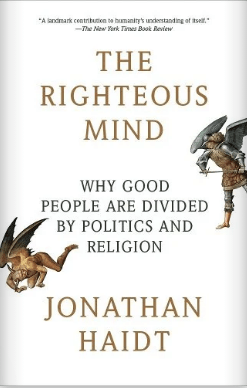
That brings us to Jonathan Haidt and his book The Righteous Mind: Why Good People Are Divided by Politics and Religion.

Theories of Morality

Before we get to Haidt’s theory, we’ll go over some of the different theories of morality.

First, we have nativist theories. Nativist theories propose that we are all born with an inner sense of morality. Religions say this comes from God (like the light of Christ in LDS doctrine). A secular version is that we’ve evolved to have moral emotions because pro-social impulses help us survive. You hear this one a lot in ex-Mormon circles.

Next, we have the empiricist model. Empiricists believe, as John Locke did, that children are blank slates at birth and that our morality or lack thereof comes from “nurture” causes.

While LDS people don’t fully believe that, there is a huge emphasis on teaching your children the gospel, and many parents tend to blame themselves when their kids leave the Church, as though their parenting must be to blame. This is an empiricist worldview that I assume they adopt because they don’t believe their children’s spirits are somehow morally defective and don’t want to condemn their children.

That brings us to Jean Piaget, who you might know from child development theories. He’s the “kids learn through play” guy. Well, one of them. In any case, he applied his theories to morals too. He believed that children figure out morality when their minds are ready, given that they have the right kinds of experiences.

Lawrence Kohlberg expanded on this and created Kohlberg’s stages of moral reasoning. In this model, our morals and moral actions are based on reason, and our reasoning improves as we develop. This is rationalism.

To Kohlberg, parents, teachers, and other authority figures get in the way of kids’ moral development, and lectures are pointless. So this model does not value authority, hierarchy, or tradition very much.

Kohlberg’s theories reigned for a long time, meaning that our interpretations of research have supported a secular, egalitarian, and questioning worldview as the most moral. Morality, then, is about harm and fairness. Issues such as whether so-and-so can eat x food do not fall in the moral realm.

However, you also hear rationalist views from conservatives, such as, “if x is a Democrat/Catholic/whatever, then they can’t be very smart.”

Social Intuitionism

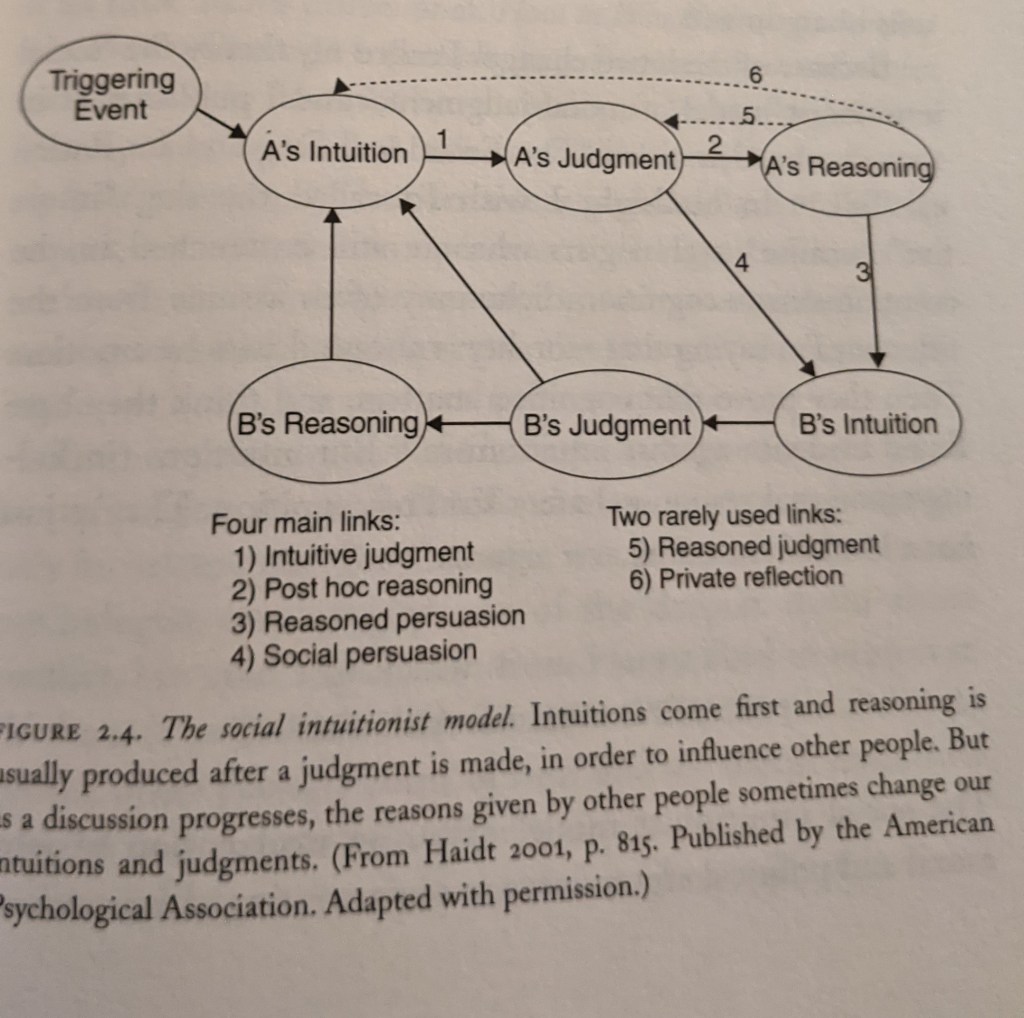
Enter Jonathan Haidt. He found some holes in Kohlberg’s research and, as he explains in the book, demonstrates that people make decisions primarily based on intuition. Our moral reasoning is most often something we come up with after we’ve decided what we think.

He likens our moral reasoning to an elephant with a rider. The rider, our reasoning, can sometimes steer the elephant and can communicate with others for the elephant. But when push comes to shove, it’s the elephant, our intuition, that’s really in charge.

Our intuition, in turn, is informed less by our own rationality than by the intuitions and judgments of other people in our social groups. That’s why you generally have to have a positive relationship with a person to change their mind; you can’t just disprove their argument.

The social intuitionist model. The bubbles show that it is rare for person A's intuition and judgment to change due to personal reasoning. It is much more likely that Person A adjusts their intuitions and judgment upon being presented with other people's judgment and reasoning.

“Reasoning can take us to almost any conclusion we want to reach, because we ask ‘Can I believe it?’ when we want to believe something, but ‘Must I believe it?’ when we don’t want to believe. The answer is almost always yes to the first question and no to the second.”—The Righteous Mind, pg. 107

Further, Haidt, himself a liberal atheist, noticed that more conservative and religious societies very much consider matters like eating practices to be moral issues.

He and his colleagues did more research but in more diverse countries and among more socioeconomic groups. Haidt found that Kohlberg’s research has a liberal bias because it was done on WEIRD (Western, educated, individualistic, rich, and democratic) populations.

That brings us to the Moral Foundations Theory.

Moral Foundations Theory

Using a bunch of research and evidence that I can’t go into here because that’s the book, Haidt and his colleagues created the Moral Foundations Theory.

In this theory, we have evolved with several (at least six known) moral foundations: care versus harm, fairness versus cheating, liberty versus oppression, loyalty versus betrayal, authority versus subversion, and sanctity versus degradation.

These foundations are like taste receptors, and our culture and social groups then influence how and what we perceive as part of these foundations. Thus forms our moral intuition.

WEIRD cultures tend to have a narrower understanding of what counts as a moral issue. American liberals value care, liberty, and fairness, in that order, over loyalty, authority, and sanctity. Caring for victims of oppression is the most sacred value.

The liberal moral matrix of American liberals, who value care, liberty, and fairness over loyalty, authority, and sanctity.

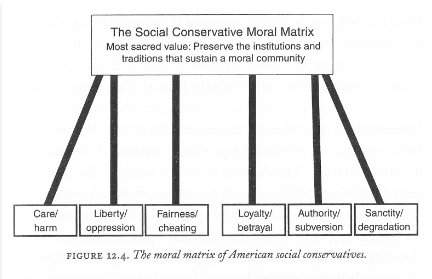
More socially conservative, sociocentric cultures and people, including within the United States, tend have a more even emphasis on all six foundations. For American conservatives, the most sacred value is preserving the traditions and institutions that sustain moral communities. (Note that when we’re talking about American conservatives here, we’re talking about proper conservatives, not what the modern GOP has become.)

The moral matrix of American conservatives, who value all the values more equally than do liberals.

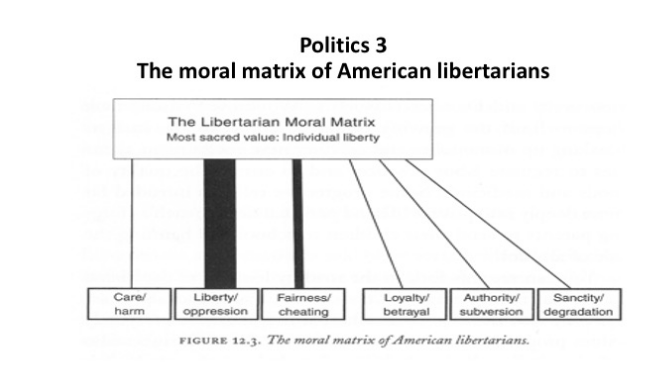
And then you have American libertarians, who value liberty far more than anything else.

The moral matrix of American libertarians, who value liberty most of all, then fairness, and then everything else.

This brings us to a final important insight in this discussion, which is that “morality binds and blinds.”

Moral Teams

Humans are, in Haidt’s words, “90% chimp and 10% bee,” and that means that we form hives (whether we think we’re doing that or not). Once we join a team, be it political or religious, we buy into that group’s moral matrix and become blind to other ways of viewing morality and the world. This makes us all massive hypocrites.

This is why we are at the point where your friends and family who have known you forever and believe you to be a good person might be asking how you can expect to live a moral life outside the group. Mormonism is a sociocentric, socially conservative group that highly values loyalty and authority, and ex-Mormons violate two of those values just by leaving the Church. Throw in any sanctity violations, such as drinking coffee or having premarital sex, and people think you are in the grip of Satan.

Takeaways for Ex-Mormons

So what have we learned? Here are some lessons to takeaway (for we still must liken all helpful texts unto ourselves for our profit and learning):

  • You now have an explanation for how you and any kids you have will be moral people.
  • You now know that to most effectively teach your children moral values, they need a “moral team” to guide their moral intuition. Traditionally, religion fills this role, but some ex-Mormons form “pods” of a few like-minded families who have kids around the same age.
  • You and your TBM friends and family are working with different moral matrices now. Each of you learning to see things from the other’s point of view can go a long way toward making peace. Hopefully this is possible because Mormonism exists within the larger cultures of the countries where people live, and you used to be Mormon.
  • You know that for someone to change their mind, especially about something as huge as a religion they’ve dedicated their life to, they’d need a whole lot of input on their moral intuitions. So just you arguing with people about religion is unlikely to make a difference. Positive relationships are more likely to soften people’s points of view and open them up to alternate perspectives.

So there you go! Social intuitionism and Moral Foundations Theory. You can read the chapter about the foundations here. If you’d like to read more about moral foundations or about your own moral foundations, go to yourmorals.org.

Book Review: The Righteous Mind, by Jonathan Haidt

Perhaps my favorite post-Mormon read so far has been The Righteous Mind: Why Good People Are Divided by Politics and Religion, by Jonathan Haidt.

I love this book because it presents the best theories I’m aware of for how morality and belief work. Both of these explanations can be extremely helpful to ex-Mormons who are deconstructing, and I hope the information will bring you insight and maybe a bit of peace.

Questions This Book Addresses

I’ll dedicate a post to the details of how morality works as well as one to how belief works, but for now the thing to know is that Haidt proposes the social intuitionist model. This model addresses questions like:

  • Where does morality come from?
  • Why do we believe the things we do?
  • Why do seemingly good people come to such different conclusions?
  • Why does my family think I’m being wicked just because I [don’t wear garments, drink coffee, etc.]?
  • Why aren’t my loved ones willing to talk about things I’ve learned about the Church?
  • Why do Church standards encompass so many different areas of life?
  • Why did it take me so long to stop believing in the LDS gospel?
  • How can people still believe when they know so many horrible things about the Church?
  • Why are my loved ones jumping to their doom by voting for the GOP?
  • Why aren’t my loved ones willing to accept me for who I am when they supposedly love me?
  • How do I raise children to be moral when my whole framework for doing that is gone?
  • What role does religion serve in society?

This book gives us a lot of answers about morality, belief, and society.

Other Aspects of This Book

The Righteous Mind is dense but a rewarding read. The points are clear and presented according to the principles that Haidt lays out for convincing people of your ideas. His arguments are compelling, and he explains and engages with competing theories, such as Kohlberg’s stages of moral reasoning and the New Atheist approach to religion.

The organization and structure are coherent and clear, as are the mechanics and the presentation of the material to a lay audience.

Some day, I will review a book on this site and not give it 5 stars. Today is not that day. 5 stars.

Rating: 5 out of 5.

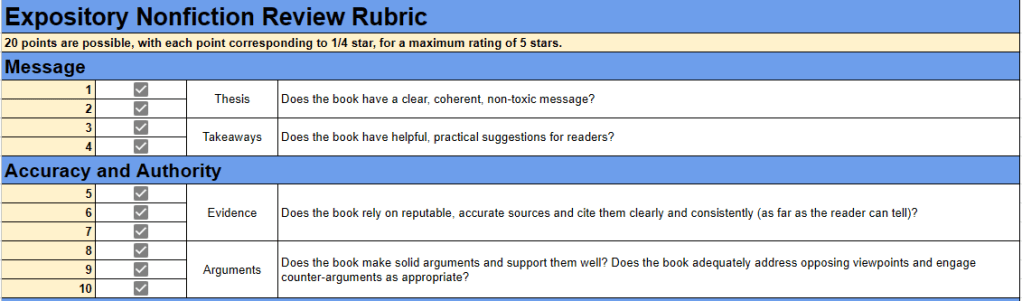
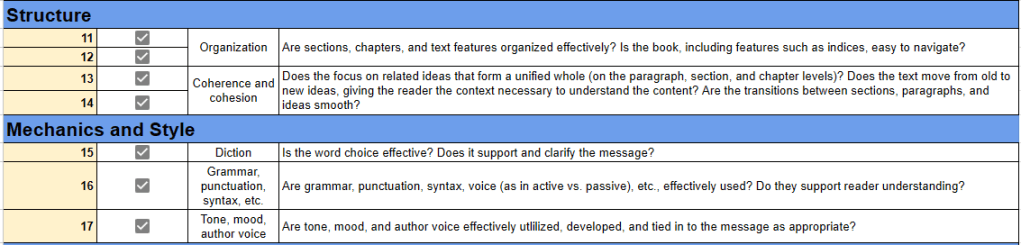
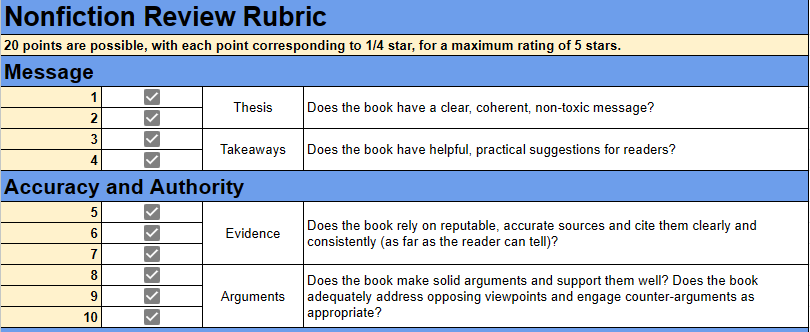
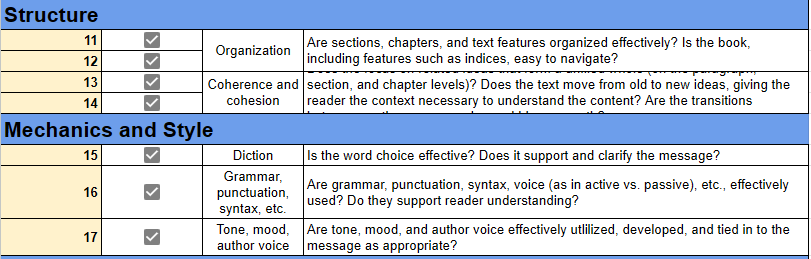
Screenshot of book review rubric. Link to the rubric is on the About page.

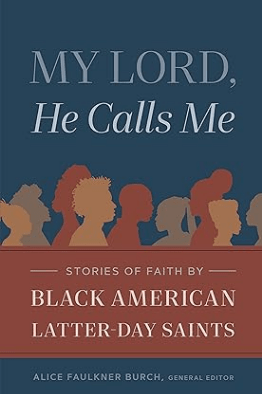
Book Review: My Lord, He Calls Me, Edited by Alice Faulkner Burch

The full title of the book I’m reviewing is My Lord, He Calls Me: Stories of Faith by Black American Latter-day Saints, a collection edited by Alice Faulkner Burch. This is a collection of firsthand accounts, meaning that my expository nonfiction review rubric isn’t quite appropriate and neither is my creative nonfiction one, seeing as I am judging a bunch of accounts by laypeople and judging their writing style just feels mean. In any case, I recommend this book.

If you’re wondering why I’m talking about such a faith-promoting book on a site dedicated to collecting resources for ex-Mormons, then don’t worry—I’m about to tell you!

Why Ex-Mormons Might Want to Read This

My Lord, He Calls Me can indeed be a tough read if you’re deconstructing. Reading stories of faith when the writers are talking about enduring struggles caused by the racism of the Church they belong to, a Church you no longer believe is God’s organization, will make you sad and probably angry.

There are accounts from teenagers in the book, and I wonder how they might feel about being in this book when they get older.

Another example: One writer says that they believe that Heavenly Father allowed her to accept the missionaries’ answer to her questions about why there were no Black men in leadership because if she had known then what she knows now, she would have never joined the Church.

Oof.

On a more historical note, this book also contains firsthand accounts of Black members throughout the Church’s history. That means a phenomenal collection of writings from early Church history and from during the priesthood and temple restrictions on Black members. There’s a personal history by Jane Manning James as well as a man who was part of a group of Black men that worked with apostles, trying to get them to broaden their perspectives and opinions. These are essential perspectives from Church history that anyone interested in understanding Mormonism needs.

Further, non-Black ex-Mormons need to understand more about what it’s like to be a faithful Black Mormon if we’re going to better understand and support Black ex-Mormons. It’s also important to support Black Mormons where they are, whether they believe or not, so as to not make them pawns in your angst against the Church. Obviously I also recommend reading and listening to Black ex-Mormon accounts of what being in the Church was like, but engaging with faithful members’ stories can help you focus on supporting the people rather than using their accounts to support your own worldview.

So maybe don’t read this book right after you stop believing, but do make reading historical accounts by Black members a priority if you’re interested in Church history, and make reading or listening to accounts of contemporary members a priority at some point in your faith transition process.

How This Book Expanded My Perspective

The accounts in this book deal fairly frankly with racism from members. It does not go hard on systemic racism in the same way that Mormonism in White Supremacy does because that’s not what this book is about. Here are a few of my takeaways.

First, many Black members who grew up in the Church came into the Church via adoption into white families, so the Black Mormon experience often intersects with trans-racial adoption. (The editor, Alice Faulkner Burch, has worked a lot with white parents to help them make their parenting more culturally competent.)

Second, while I had assumed that most Black Mormons who join the Church and stay in the Church do so despite the issues re: race (and that’s true), many of the writers also indicate that they joined the Church in part because of their relationship with race. How people relate to race and identity is complicated.

The account of Jane Manning James was particularly moving in this regard. She describes how, when journeying to Nauvoo, she and her group were arrested and asked to present papers proving they weren’t runaway slaves. And then they had to walk to Nauvoo because they weren’t allowed on more efficient, comfortable transportation due to their race. And then they got to Nauvoo, where Joseph Smith gave her a home, a warm welcome, and a promise that she was among friends now and would be protected.

I am far from a fan of Joseph Smith, but I get why those experiences would influence her to join the Church in part because of how racism affected her. Context is important, and sometimes, Mormonism has offered more racial justice than the rest of the world.

Third, there’s an essay that talks about how Ethiopia was a Christian nation before Spain, England, or Portugal, and how the first Angolans who were held captive and enslaved in Virginia were Christian. That’s not to say that Christianity has not also been a tool of white supremacy, but knowing that history is particularly important for Black Christians who understandably don’t want to view their religion and salvation as contingent on Black chattel slavery.

The book also includes poetry, and that was both good to read and a nice way to break up sections of the book.

So overall, I appreciated the opportunity to read this book. It’s well-organized and edited and has accounts of historical significance.

Michael Servetus, John Calvin, and Progressive Mormon Reformers

I will burn, but this is a mere incident. We shall continue our discussion in eternity. —Michael Servetus

As part of my research into Unitarian Universalism, I’m watching Long Strange Trip, which is a six-part documentary about the history of Unitarianism, Universalism, and Unitarian Universalism. I recently watched part one, which covers the beginning of the Christian era through the life of Michael Servetus.

The film is set before the formal start of Unitarianism or Universalism, so the focus is on the people and ideas who contributed to the later movements.

The documentary approach is just a white dude telling you things while the setting and background changes, and sometimes they do voiceover while showing pictures of the people involved. So not terrible, but not a particularly engaging format either.

What most caught my interest was the quiet connection to Joseph Smith and Mormonism.

Similar Ideas

I don’t know enough about Joseph Smith’s education to know if he was familiar with Servetus, but Servetus’s ideas are similar to those of Smith and Swedenborg (who also had ideas similar to Joseph Smith’s), and many non-Trinitarian Christian groups draw on Servetus’s ideas.

I was struck by the language Michael Servetus used to describe how Christianity and its preferred Bible translations had become “corrupted.” His words sound a lot like those spoken by Jesus to Joseph Smith in the First Vision narrative and a lot like some traditional LDS teachings on issues with the Bible.

Servetus was also against infant baptism, which he called an invention of the devil. The Book of Mormon is of the same mind.

So at least among nonbelievers, I think it’s fair to say that Servetus, directly or indirectly, influenced the founding of Mormonism.

Mormon Phoenix

Even more fascinating is how Servetus’s life and death are metaphorically and cyclically echoed in LDS history.

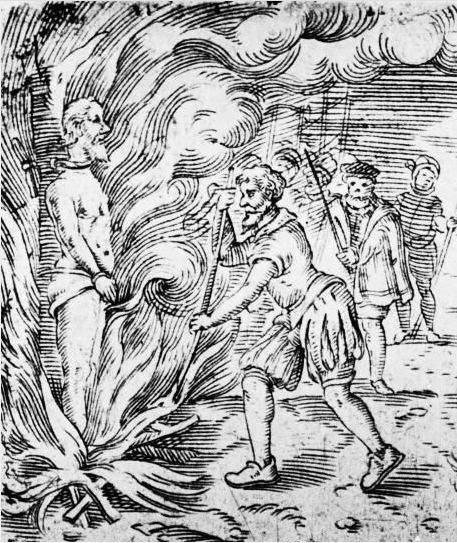
Both the Catholic and Protestant authorities were after Servetus, and in 1553, he was burned at the stake at Geneva under the influence of John Calvin, a fellow reformer. Geneva was John Calvin’s scene, and Calvin had told Servetus that he set foot in Geneva, he wouldn’t leave alive. So why Michael Servetus would go there if he didn’t want to die is unclear. The documentary suggests that he felt compelled to debate and engage with Calvin. In fact, Servetus was arrested after attending one of Calvin’s sermons.

I see both John Calvin’s more authoritarian determination and enforcement and Michael Servetus’s indomitable heresy in Mormonism, starting with Joseph Smith.

Perhaps this is not surprising. One of the children of John Calvin’s thoughts is Presbyterianism, and Lucy Mack Smith joined a Presbyterian church. One of the children of Michael Servetus’s ideas is Universalism, and Joseph Smith, Sr., had a universalist background. One of their literal children founded Mormonism.

In any case, Church leadership dons the mantle of Calvin whenever they excommunicate progressive Mormons. These reformers are the Toscanos and Quinns and Andersons of the world, people who continue to publish and to push for change despite the knowledge that the larger institutional powers will probably crush them.

Person after person is silenced, but every time a Servetus burns, another heretic is born from the ashes. In a Church with a founding story about learning from God for yourself, how could this not happen over and over?

Servetus’s death didn’t work out so well for Calvin. Calvin was widely condemned for the execution. Likewise, the Church has increasingly become careful with excommunications because ex-ing someone can invite a lot of blowback and hurt the Church’s reputation.

Things may settle down for a while, but the little phoenix will come back again in a burst of fire and new life. Perhaps this is just how humans work—some people will always break with the status quo. But I find it more satisfying and poetic to think that even if there’s no afterlife, Michael Servetus was right.

Upon being sentenced to death, he said, “I will burn, but this is a mere incident. We shall continue our discussion in eternity.”

There’s something beautiful in the idea that no matter how many times Calvin tries to kill Servetus, the reformer always returns, even if, like a moth, he is drawn to the flame each time.

But Calvin gets weaker each time too.

Servetus’s spirit is alive and well when heretics in any denomination push for heterodoxy, for free thinking and freedom of belief.

Long live that phoenix.

Book Review: BLUU Notes, edited by Takiyah Nur Amin and Mykal Slack

I’m not trying to convert you, but I am going to a Unitarian Universalist church and researching its history, so you’re going to hear a bit about it.

In this post, we’re talking about BLUU Notes: An Anthology of Love, Justice, and Liberation, edited by Takiyah Nur Amin and Mykal Slack. I loved it. 5 stars.

BLUU

BLUU stands for Black Lives of Unitarian Universalism, an organization that is kind of like the Genesis group in that it is a group that gives support to Black members of a predominantly white religion. However, it is also very much not like the Genesis group because it does community organizing and advocacy work for racial justice independent of the larger organization and calls publicly and unapologetically for expanded Black power in Unitarian Universalism and the world at large.

(If you are a Black person interested in BLUU but not Unitarian Universalism more broadly, it looks like BLUU welcomes all justice-minded Black people.)

Highlights

This book contains BLUU’s Seven Principles of Black Lives and poetry, music, and prose by Black UUs. The book is intended to be a resource for worship, meditation, and reflection, and its contents are worth coming back to over and over. Doing this is easy to do because the book is short and physically small, so it can be fit into a purse or a large pocket.

As I reviewed the book while writing this review, I came across the short essay “Sankofa—Go Back and Get It,” by Jan Carpenter Tucker. Sankofa, the author tells us, is a Twi term that mean “it is not taboo to fetch what is at risk of being left behind.” Rereading this book felt like going back for something I’d forgotten. Of course I know about justice and support Black thriving; still, this book centered and rejuvenated me.

This book radiates with the spirit of joy and justice. 5 stars.

Screenshot of book review rubric, a link to which is on the About page.

Eternity of Cats

Resources for Mormon Faith Transitions

Skip to content ↓